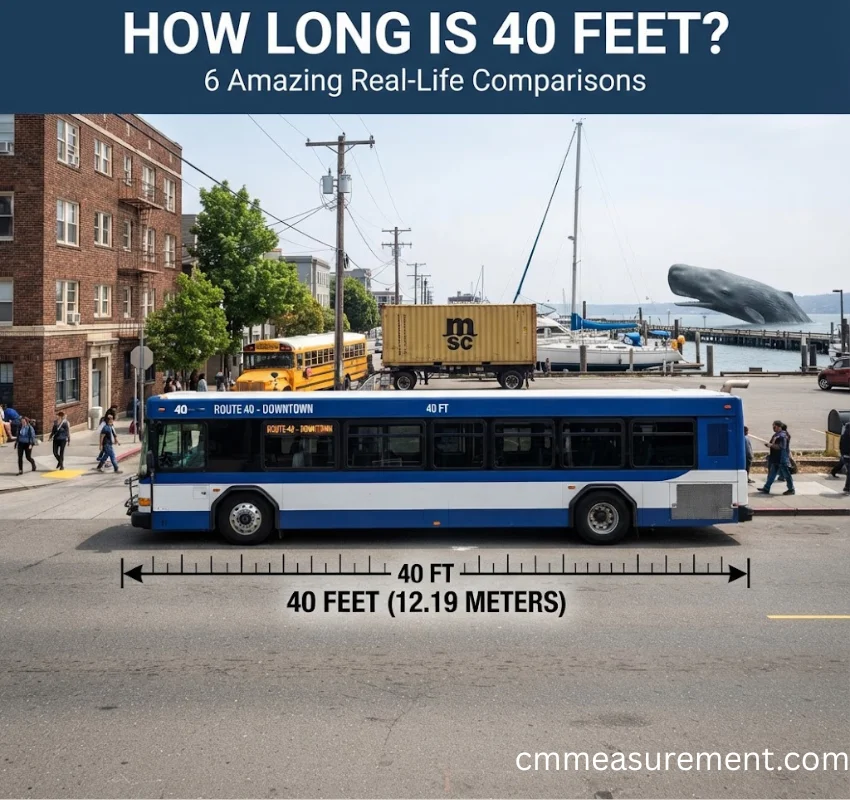
A city bus pulls up to your stop. Front bumper to rear bumper, that vehicle stretches almost exactly 40 feet.
Numbers on a page rarely stick. This guide fixes that with the exact conversions, six sourced real-world comparisons, and clear answers to how 40 feet stacks up against a building and a human body.
Table of Contents
How Long Is 40 Feet? (Quick Answer + Conversion Chart)
40 feet equals 12.19 meters, 480 inches, 13.33 yards, and 1,219.2 centimeters.
A foot belongs to the US customary system, the imperial measurement standard used across America for construction, transportation, and everyday distance. One foot always equals 12 inches, a fixed ratio that hasn’t changed since the US formally adopted its measurement standards.
| Feet | Meters | Inches | Yards |
|---|---|---|---|
| 10 ft | 3.05 m | 120 in | 3.33 yd |
| 20 ft | 6.10 m | 240 in | 6.67 yd |
| 30 ft | 9.14 m | 360 in | 10 yd |
| 40 ft | 12.19 m | 480 in | 13.33 yd |
That’s the math. Now let’s connect it to things you already recognize.
6 Real-Life Comparisons to Visualize 40 Feet
What is 40 feet compared to? These six references pull from shipping, transportation, and marine life — the categories where this exact length shows up most often in American daily life.
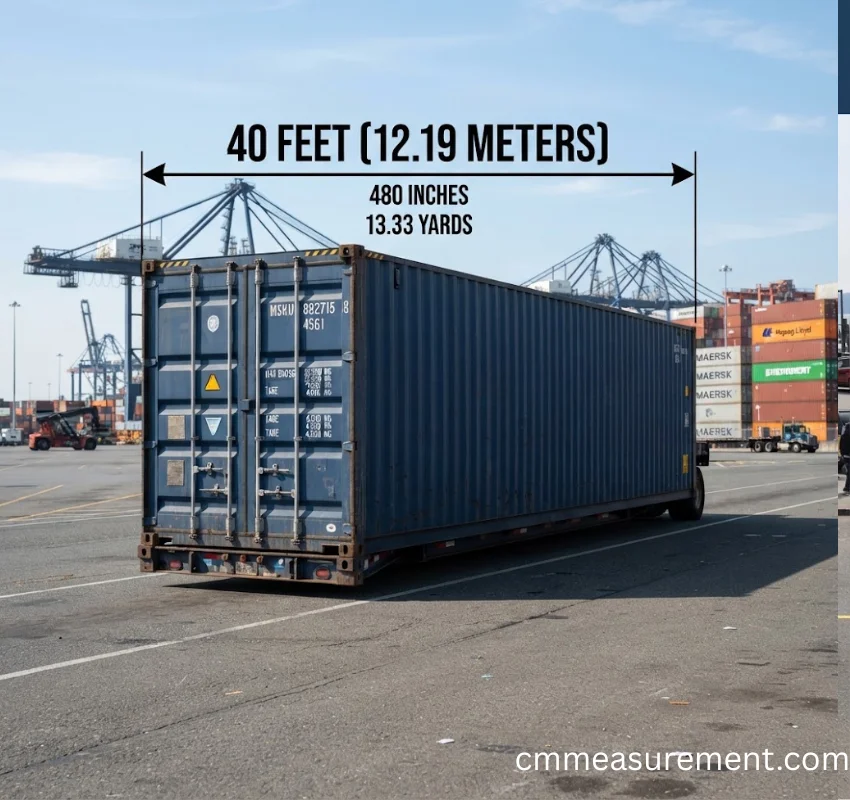
A 40-foot high-cube shipping container. This is the dominant cargo container size moving goods through American ports, from Los Angeles to Savannah. ISO shipping standards fix this container at exactly 40 feet, and major retailers rely on it daily to stock store shelves nationwide.
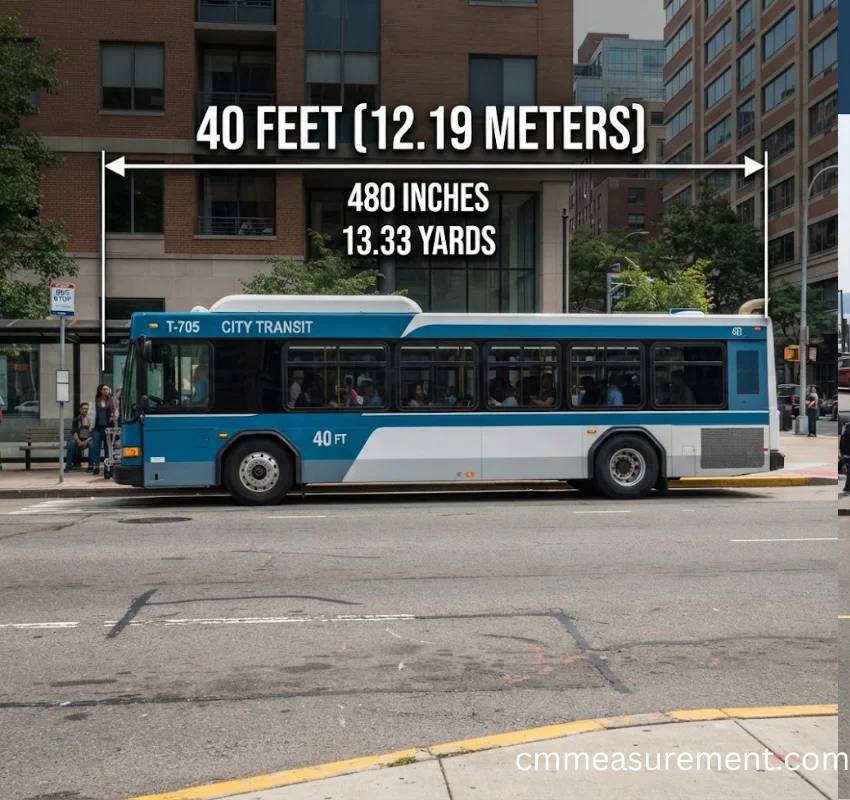
A full-size city transit bus. The American Public Transportation Association (APTA) recognizes 40 feet as the standard length for single-unit buses running fixed routes across US cities. It’s the most common large vehicle on American streets after the passenger car.
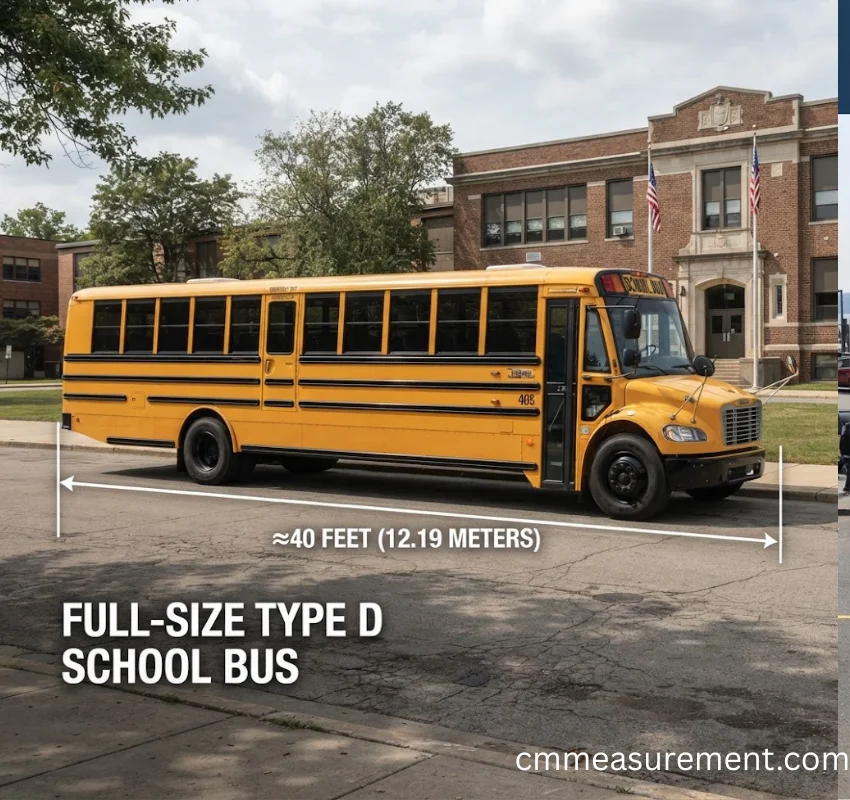
A full-size school bus. A Type D school bus, the largest classification on the road, measures close to 40 feet and can carry up to 72 passengers. School districts plan driveways and drop-off zones around this exact turning radius every single day.
Must Visit: How Long Is 500 Feet? 7 Incredible Real-Life Comparisons to Visualize This Massive Distance
A large female sperm whale. According to NOAA’s National Marine Fisheries Service, female sperm whales regularly reach 40 feet in length along US coastlines. It’s one of the most dramatic natural comparisons for this measurement — matching a school bus against the largest toothed predator on Earth.

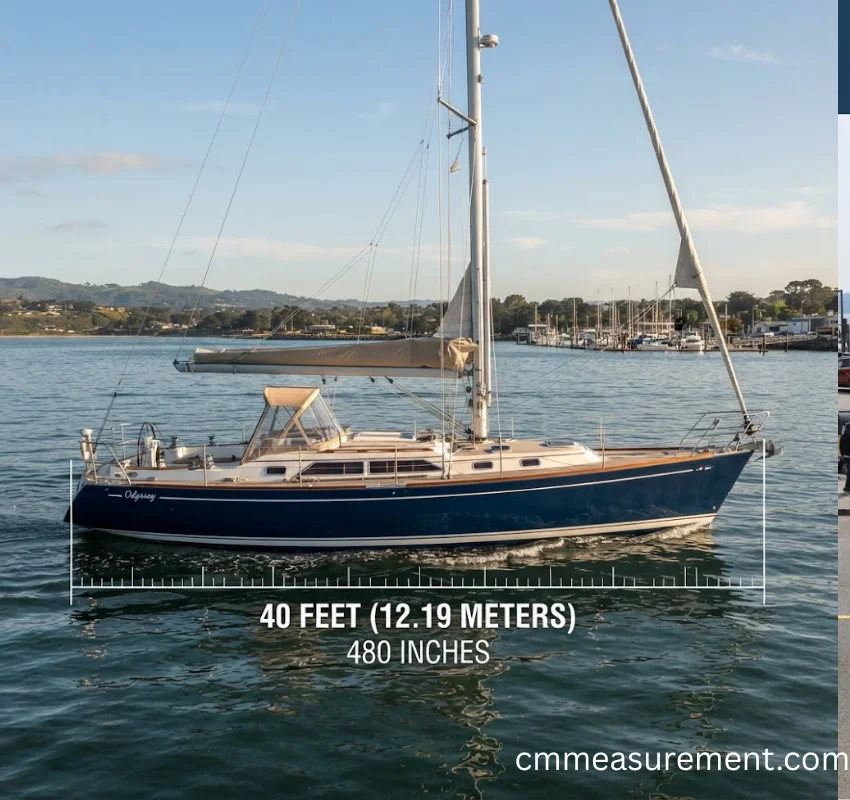
A mid-size motor yacht or sailboat. A 40-foot sailboat marks the entry point into serious offshore cruising for American boaters. Brands like Beneteau, Catalina, and Hunter build flagship models at this exact length because it balances interior space with manageable handling.
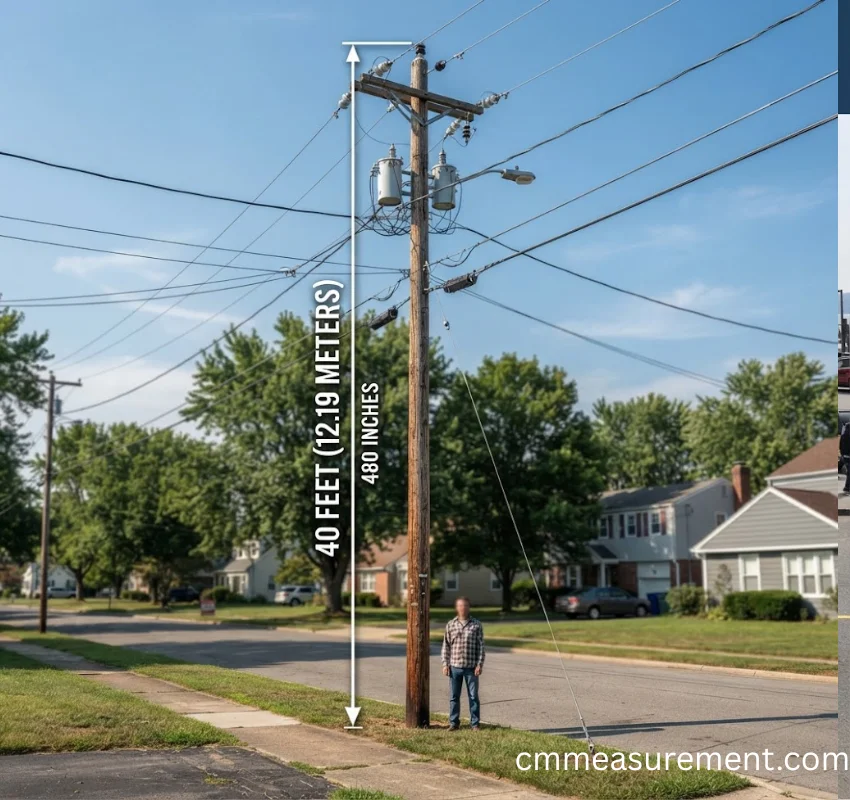
A telephone pole. Utility poles across the US commonly stand near 40 feet tall, based on figures reported by state public service commissions. Most are made of treated wood, typically pine, and last 25 to 50 years depending on climate.
How Tall Is a 40 Feet Building?
How tall is a 40 feet building? A standard 4-story building reaches about 40 feet, based on the common construction standard of roughly 10 feet per floor used across US residential and commercial projects.
What does 40 ft tall look like? Look up at the fourth floor of any mid-rise apartment building, boutique hotel, or suburban office park, and you’re looking at roughly 40 feet of vertical height. It’s a scale found in nearly every American downtown and neighborhood.
This height carries real regulatory weight too. International Building Code (IBC) standards treat 40 feet as a key threshold — crossing it triggers stricter fire-resistance and stairwell requirements for architects and developers nationwide.
How Tall Is 40 Feet Compared to a Human?
How tall is 40ft compared to a human? The average American adult stands close to 5 feet 8 inches, according to commonly cited CDC height data. Dividing 40 by that figure means roughly seven adults stacked head to foot would reach the full 40-foot mark.
What does 40 feet look like from a human perspective? Picture seven people standing on each other’s shoulders — an unstable, almost impossible stack in real life, which is exactly why 40 feet feels so towering when you encounter it as a single structure or vehicle instead.
How to Visualize 40 Feet Without a Measuring Tape
You don’t need a tape measure to estimate 40 feet accurately. These methods work almost every time, based on how consistently their real-world dimensions are regulated.
| Method | Accuracy | How to Use It |
|---|---|---|
| City transit bus length | Very High | Nearly every US metro bus measures 40 feet exactly |
| 4-story building height | Very High | Count floors, multiply by 10 feet each |
| School bus length | Very High | Type D buses are standardized nationwide |
| Two car lengths plus a bit | Moderate | Useful rough estimate without a fixed object nearby |
The most reliable method is the city transit bus. Because APTA standardizes this length across US transit systems, nearly any bus you see at a stop gives you an accurate, repeatable 40-foot reference.
FAQs
What does 40 feet look like?
40 feet looks like a full-size city transit bus, a 40-foot shipping container in a freight yard, or the height of a 4-story building.
What is 40 feet compared to?
40 feet compared to everyday references includes a school bus, a sperm whale, a mid-size sailboat, and a telephone pole — all common sights across the US.
What are some things that are 40 feet?
Things that are 40 feet include a shipping container, a transit bus, a Type D school bus, and a large female sperm whale.
How tall is a 40 feet building?
A 40-foot building stands about 4 stories tall, based on the standard 10-foot floor-to-floor height used in US construction.
What does 40 ft tall look like?
40 ft tall looks like the fourth floor of a typical mid-rise apartment or office building — a height visible in most American neighborhoods.
How tall is 40ft compared to a human?
40 feet equals roughly seven average American adults stacked head to foot, based on a typical adult height of 5’8″.
Conclusion
Forty feet stops feeling abstract once you connect it to a city bus, a 4-story building, or seven people stacked head to foot. Next time this measurement comes up, you’ll have a real, physical picture ready instead of just a number.

Timmy Zeeshan is the founder and lead editor of CM Measurement, where he writes and maintains a growing library of unit conversion tools and practical measurement guides. With a background in engineering and a long-standing interest in everyday math problems, Timmy started CM Measurement after growing frustrated with cluttered, ad-heavy converter websites that made simple conversions harder than they needed to be.