Twenty meters is where “furniture-sized” stops making sense. This is building-height, pool-length territory.
This guide gives you the exact conversion, a footstep-based distance check, and six real comparisons that make how long Is 20 meters actually is click instantly.
Table of Contents
How Many Feet Is 20 Meters Visually?
Let’s start with the number. Twenty meters equals 65.6 feet, or more precisely, 65 feet and 7.4 inches.
This comes from a fixed constant confirmed by the National Institute of Standards and Technology (NIST): one meter equals 3.280839895 feet. Multiply that by 20, and the exact answer is 65.6167979 feet.
Rounding down to “65 feet” is common, but it drops more than 7 inches. That gap matters at this scale — a property line, a sports field marking,or a construction layout can shift noticeably once you’re off by half a foot or more.
Here’s the quick breakdown:
| 20 Meters Equals |
|---|
| 65.6 feet |
| 65 feet, 7.4 inches |
| 787.4 inches |
| 21.87 yards |
| 2,000 centimeters |
How Far Is 20 Meters in Footsteps?
How far is 20 meters in footsteps? For most adults, it takes somewhere between 25 and 28 walking steps to cover this distance.
How many human steps is 20 meters? The math depends on stride length. An average adult stride covers roughly 0.7 to 0.8 meters per step. Divide 20 meters by that range, and you land right in the mid-to-high twenties for total steps.
Taller people naturally cover more ground per stride, so someone with a longer gait might reach 20 meters in closer to 24 steps. Someone with a shorter stride might need closer to 28 or 29.
This trick comes in handy more often than you’d expect. Pacing off a backyard, checking a parking area, or estimating a field marking all become simple once you know roughly how many steps this specific distance takes.
6 Real-Life Comparisons for 20 Meters
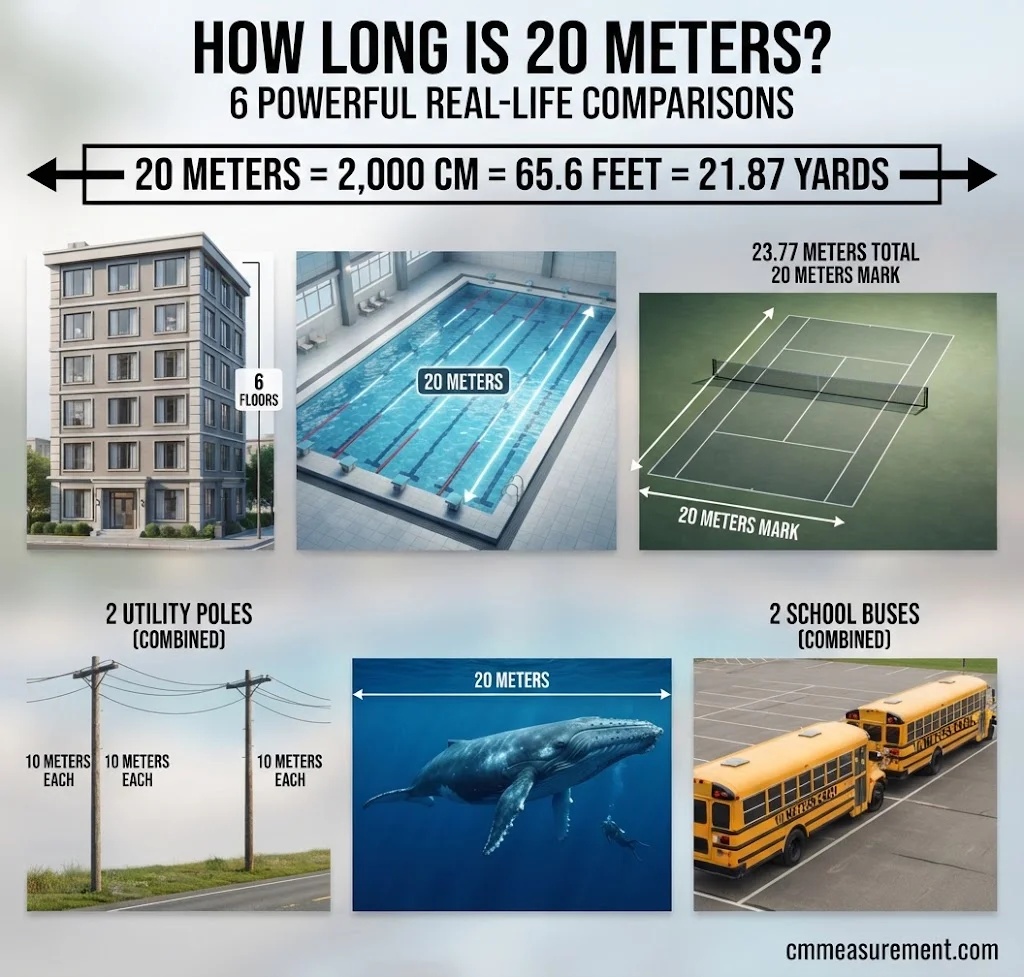
What does 20 meters look like? These six comparisons anchor the number to things you can actually picture.
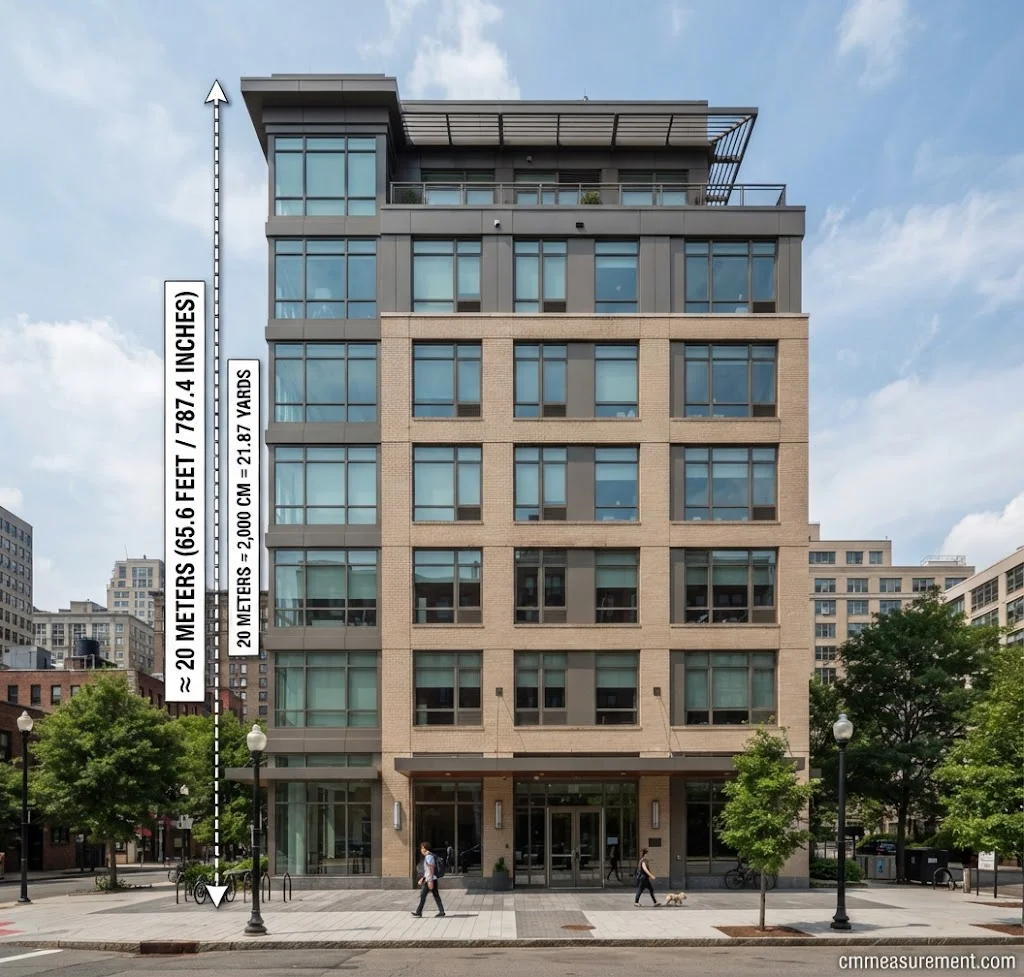
A six-story building. Architects commonly estimate about 3.3 meters, or roughly 11 feet, per floor for standard commercial buildings. Divide 20 meters by that figure, and you land close to six stories — a helpful vertical anchor for a distance most people picture horizontally.
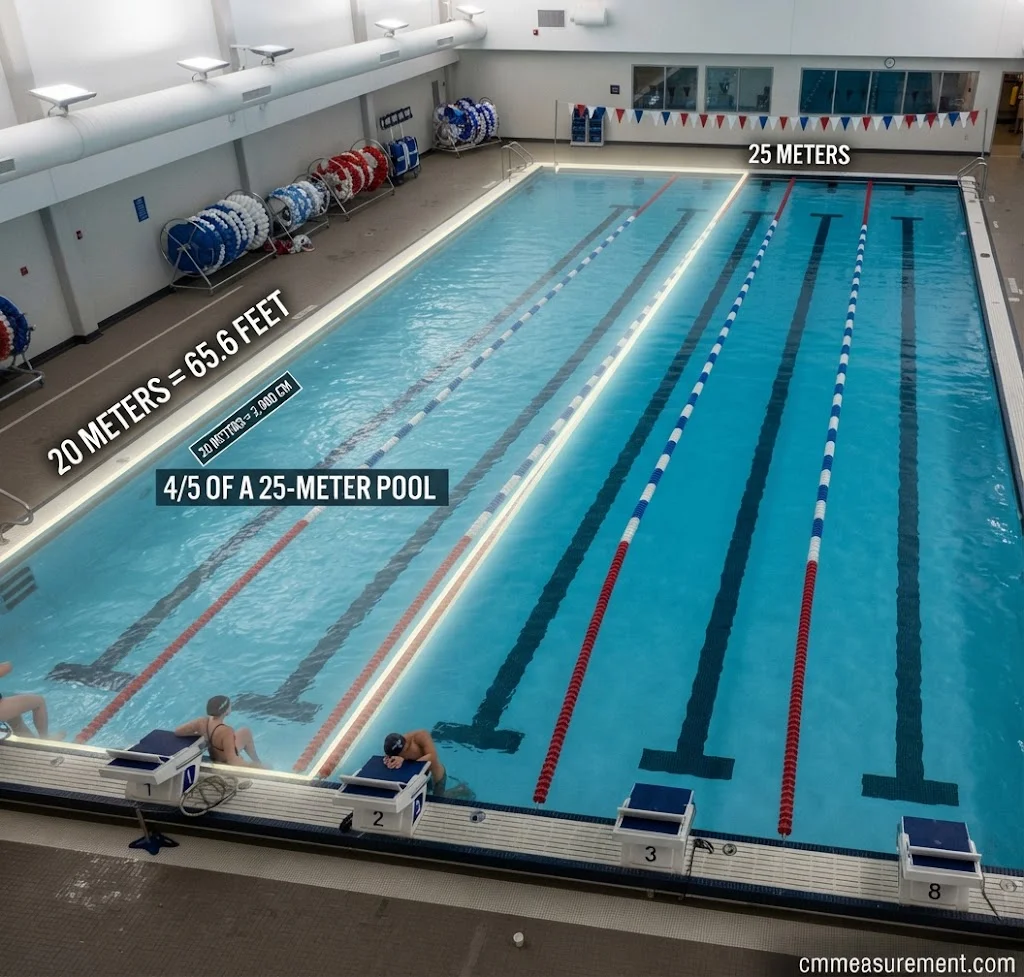
Four-fifths the length of an Olympic-size swimming pool. Competition pools are standardized at 25 meters, according to World Aquatics, the sport’s governing body. Twenty meters covers exactly four-fifths of that distance, falling just short of the far wall.
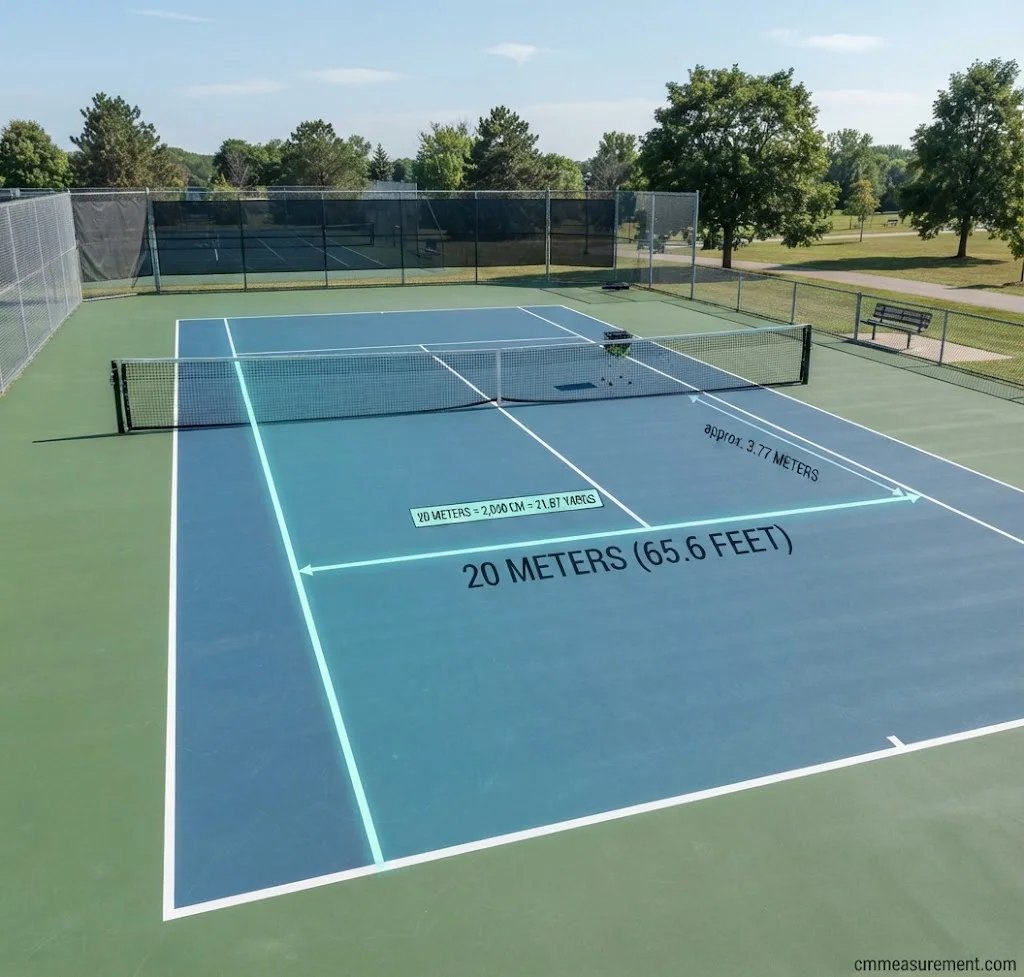
Slightly shorter than a full tennis court. A regulation tennis court measures 78 feet, or about 23.77 meters, from baseline to baseline. Twenty meters comes in a bit shorter than that full length, roughly the distance from one baseline to just past the net on the opposite side.
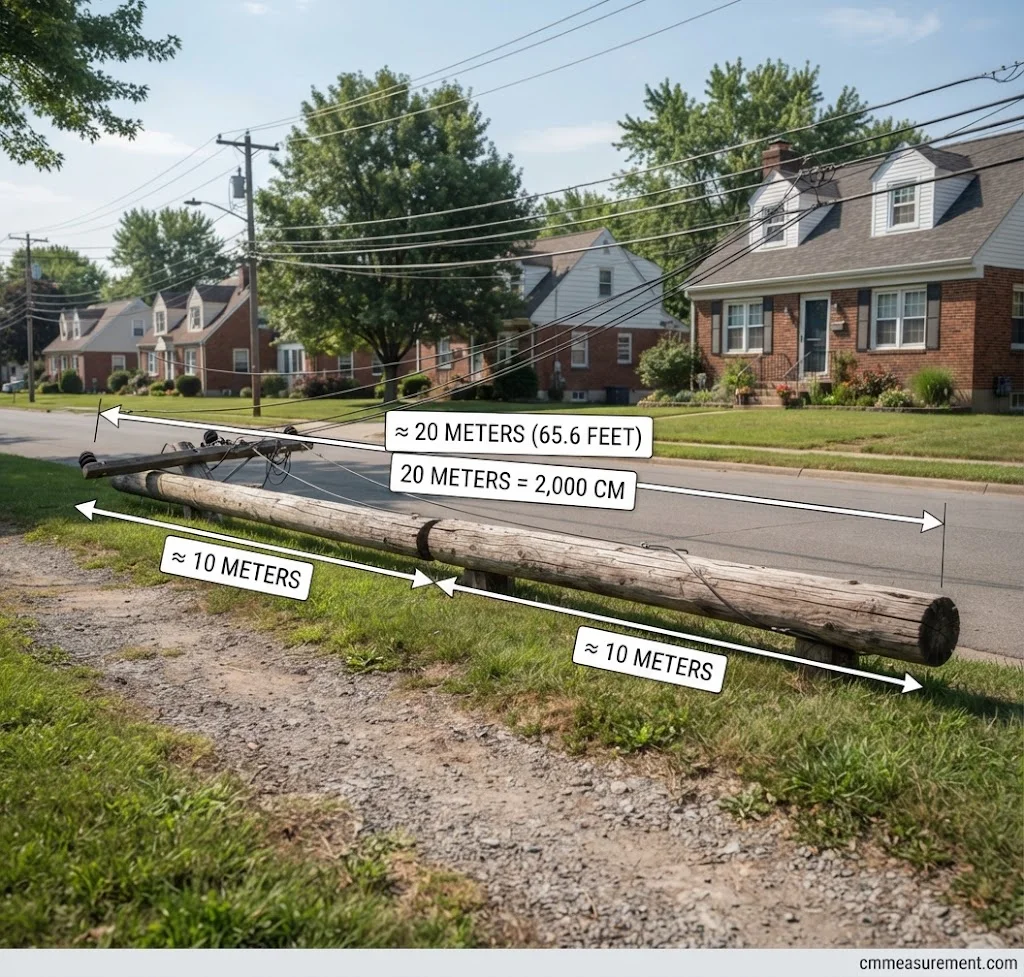
Two utility poles laid end to end. Standard wooden utility poles commonly stand between 10 and 11 meters tall above ground. Line up two of them, and you land right around this exact measurement.
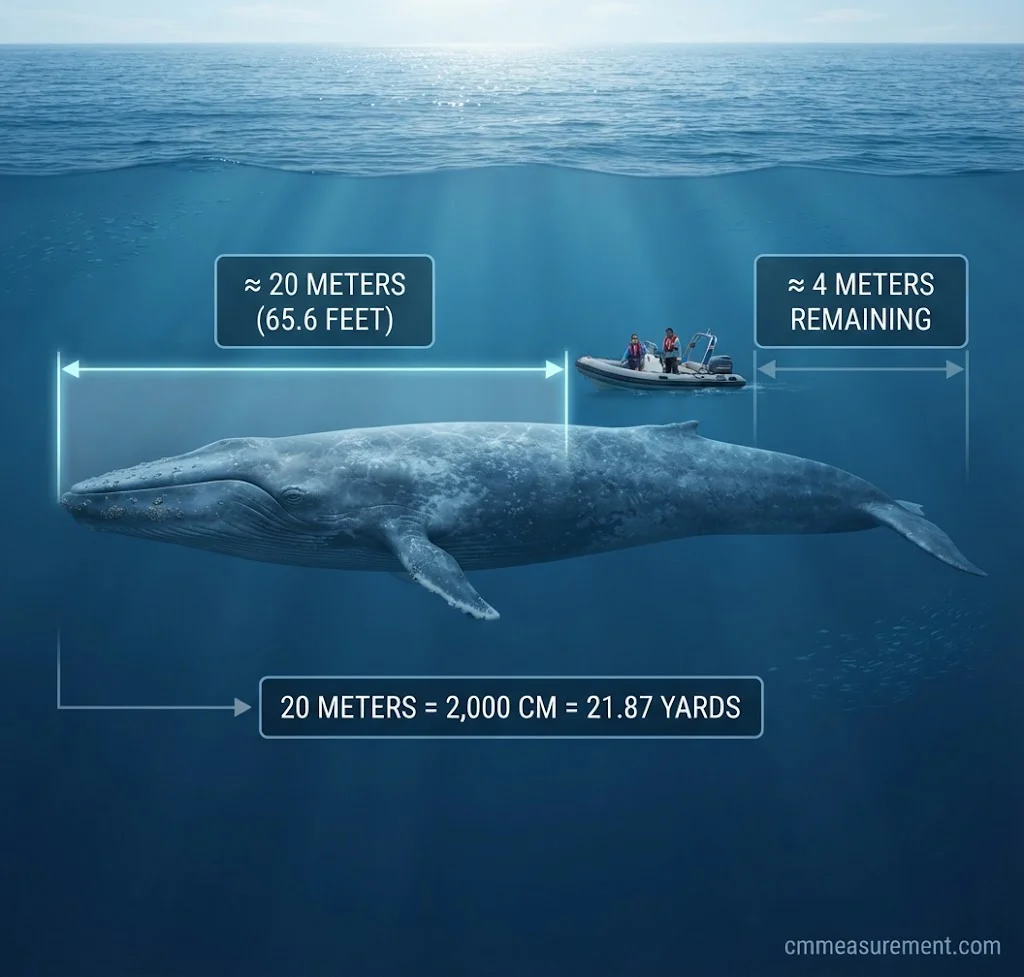
About five-sixths the length of an adult blue whale. Blue whales, the largest animals to have ever lived, typically reach around 24 meters in length as adults, according to NOAA Fisheries. Twenty meters covers most of that enormous body, falling just short of nose to tail.
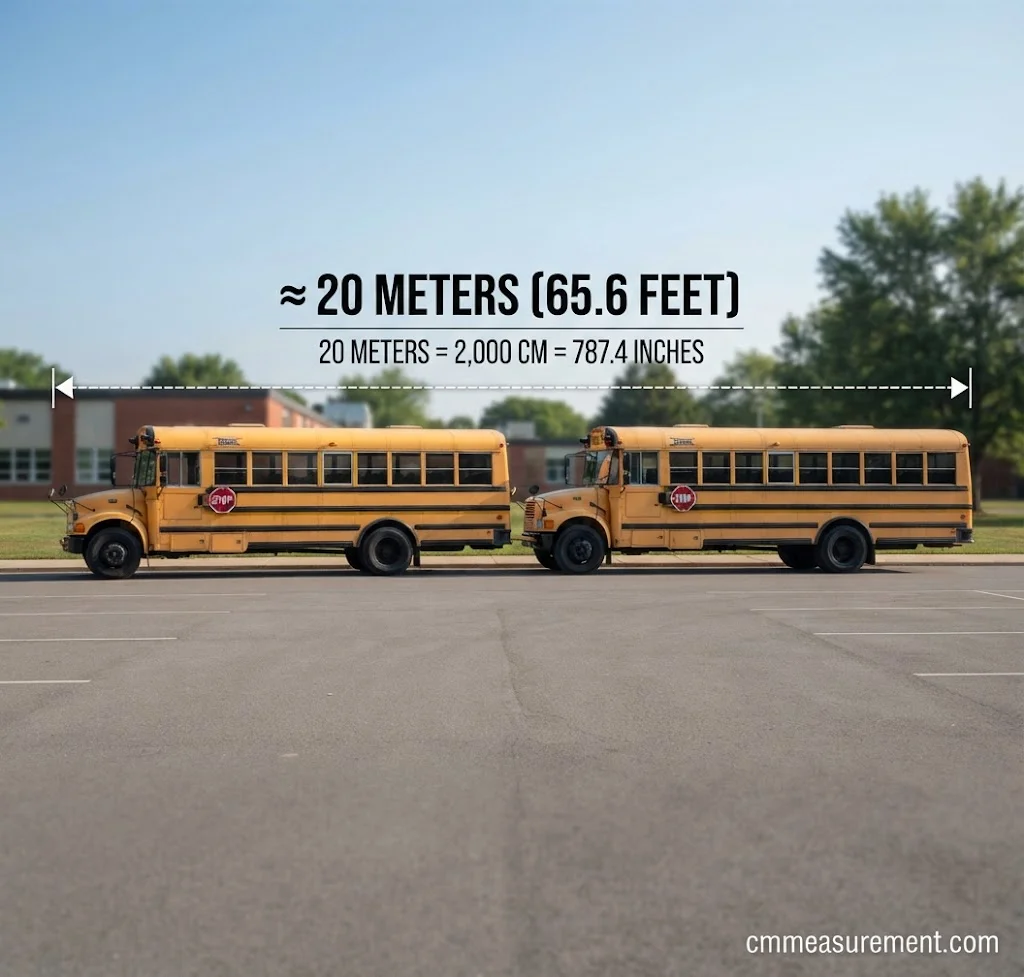
Two school buses parked end to end. Full-size school buses commonly measure between 35 and 40 feet long. Park two nose to tail, and the combined length lands close to 20 meters — a distance most drivers have unknowingly measured in a parking lot.
What Is a 20 Meters Example in Everyday Life?
How long is a 20 meters example that doesn’t require a pool or a whale? Look no further than your own street.
A long residential driveway, especially one leading to a set-back garage, often stretches close to this distance. A cul-de-sac’s diameter frequently lands in a similar range too, giving suburban homeowners a built-in daily reference.
Even a standard two-lane road, measured across both lanes plus the shoulders on either side, can approach 20 meters in total width on wider suburban streets. Once you notice it, this distance starts showing up in ordinary places you drive past every day.
FAQs About How Long 20 Meters Is
What does 20 meters look like?
Picture a six-story building, or four-fifths the length of an Olympic swimming pool. Both examples capture the scale of this distance clearly.
How long is a 20 meters example?
A long residential driveway, a cul-de-sac’s diameter, or two school buses parked end to end all serve as everyday 20 meter examples.
How long is 20m visually?
It looks like two utility poles laid end to end, or roughly the length of a tennis court minus a few feet.
How far is 20 meters in footsteps?
Most adults cover 20 meters in about 25 to 28 walking steps, depending on their natural stride length.
How many feet is 20 meters visually?
Twenty meters equals 65.6 feet, or 65 feet and 7.4 inches, based on the exact conversion factor of 3.280839895 feet per meter.
How many human steps is 20 meters?
Roughly 25 to 28 steps for most adults, since the average walking stride covers between 0.7 and 0.8 meters.
Conclusion
Twenty meters stops feeling abstract the moment you tie it to a pool length, a school bus pair, or your own driveway. Keep these comparisons in mind, and this distance will make sense the next time it comes up.

Timmy Zeeshan is the founder and lead editor of CM Measurement, where he writes and maintains a growing library of unit conversion tools and practical measurement guides. With a background in engineering and a long-standing interest in everyday math problems, Timmy started CM Measurement after growing frustrated with cluttered, ad-heavy converter websites that made simple conversions harder than they needed to be.