Fifteen centimeters shows up more often than you’d think — on shipping labels, school rulers, phone screens, and recipe cards. If you’ve ever stared at a “15 cm” measurement and wondered what that actually means in inches or feet, you’re not alone.
Here’s the short answer: 15 cm equals 5.91 inches, or about 0.49 feet. Below, we’ll break down the exact math, show you real objects that match this size, and answer the most common questions people search for.
How Long Is 15 cm? Quick Answer in Inches & Feet
15 cm = 5.91 inches, rounded to two decimal places. In feet, that’s roughly 0.49 ft, or about 5⅞ inches if you like fractions better than decimals. If you are interested to see cm into feets then must try this tool.
This gap between centimeters and inches exists because the world runs on two different measurement systems. Most countries use the metric system, where the centimeter is the standard small-length unit. The United States, however, still relies on the imperial system — inches, feet, and yards — for everyday measuring.
That’s exactly why this conversion gets searched so often. A US shopper reading “15 cm” on an imported product, or a student converting homework units, needs a fast, accurate answer — not a lecture on measurement history.
15 cm to Inches — Exact Conversion Formula & Calculation
The official conversion factor is fixed and doesn’t change: one inch always equals 2.54 centimeters, by international agreement dating back to 1959.
Formula: centimeters × 0.393701 = inches
Here’s the math for 15 cm:
15 × 0.393701 = 5.905515 inches
Most people round this to 5.91 inches for everyday use. If you need lab-level precision, keep the full decimal: 5.9055 inches.
Quick mental trick: since 1 inch is close to 2.5 cm, you can estimate fast by dividing the cm figure by 2.5. For 15 cm, that’s 15 ÷ 2.5 = 6 — a rough but handy shortcut when you don’t have a calculator handy.
15 cm in Feet, Inches & Other Units (Conversion Table)
Since a foot contains 12 inches, 15 cm breaks down to 0 feet and 5.91 inches — it’s smaller than half a foot. Written as a mixed measurement, that’s 0 ft 5⅞ in.
Seeing nearby values side-by-side often makes a single number click faster. Here’s how 15 cm compares to the centimeters around it:
| Centimeters | Inches | Feet | Millimeters |
|---|---|---|---|
| 10 cm | 3.94 in | 0.33 ft | 100 mm |
| 12 cm | 4.72 in | 0.39 ft | 120 mm |
| 15 cm | 5.91 in | 0.49 ft | 150 mm |
| 18 cm | 7.09 in | 0.59 ft | 180 mm |
| 20 cm | 7.87 in | 0.66 ft | 200 mm |
For most US-based tasks — shopping, home projects, or checking a shipped item’s dimensions — inches is the more intuitive unit. Feet only becomes useful once you’re measuring furniture, rooms, or anything closer to a yard in length.
What Is 15 cm Equal To? 6 Real-Life Examples You Can Picture
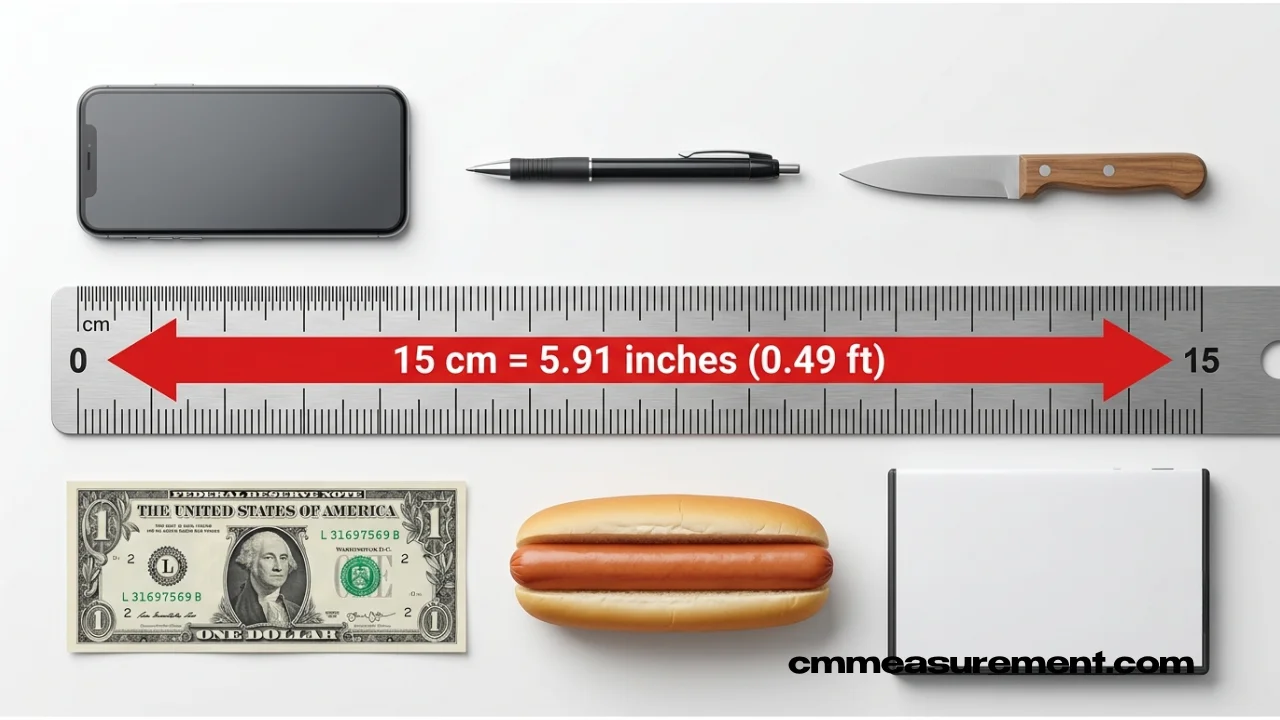
Numbers stick better when you can picture them. Here are six familiar, US-friendly objects that measure close to 15 cm (5.9 inches):
Must Visit: How Long Is 10 cm? See Its Actual Size With 7 Everyday Objects
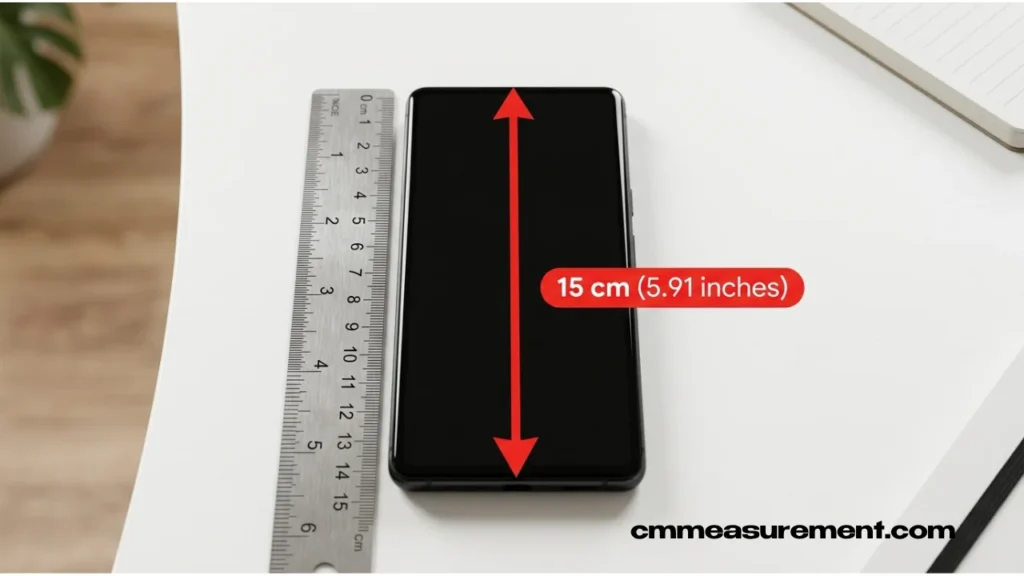
A standard smartphone — Most modern phones, including budget and mid-range Android models, measure between 5.7 and 6.1 inches tall, landing right around the 15 cm mark.
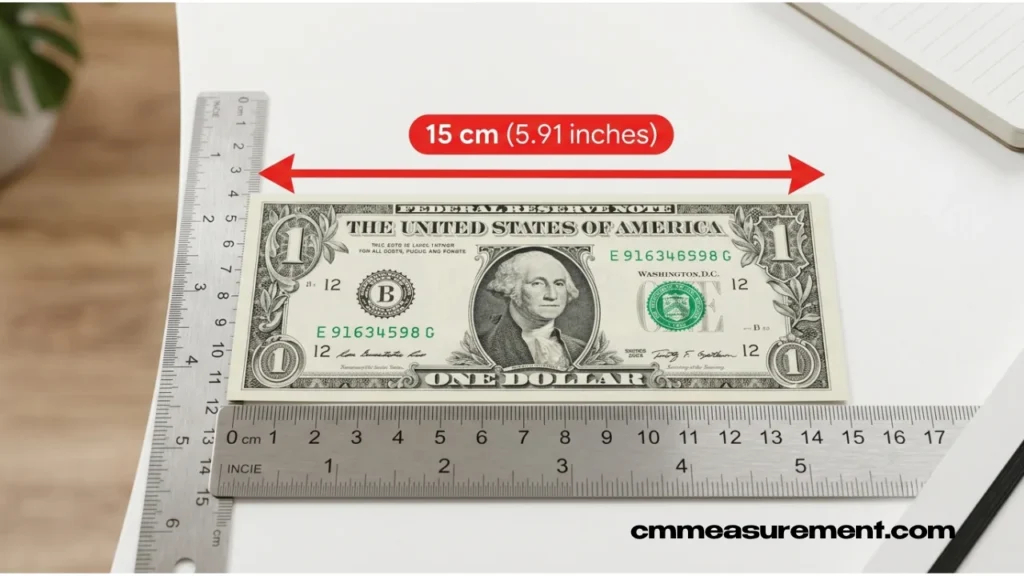
A dollar bill’s length — A US bill measures about 6.14 inches long, just slightly longer than 15 cm, making it a near-perfect everyday reference.
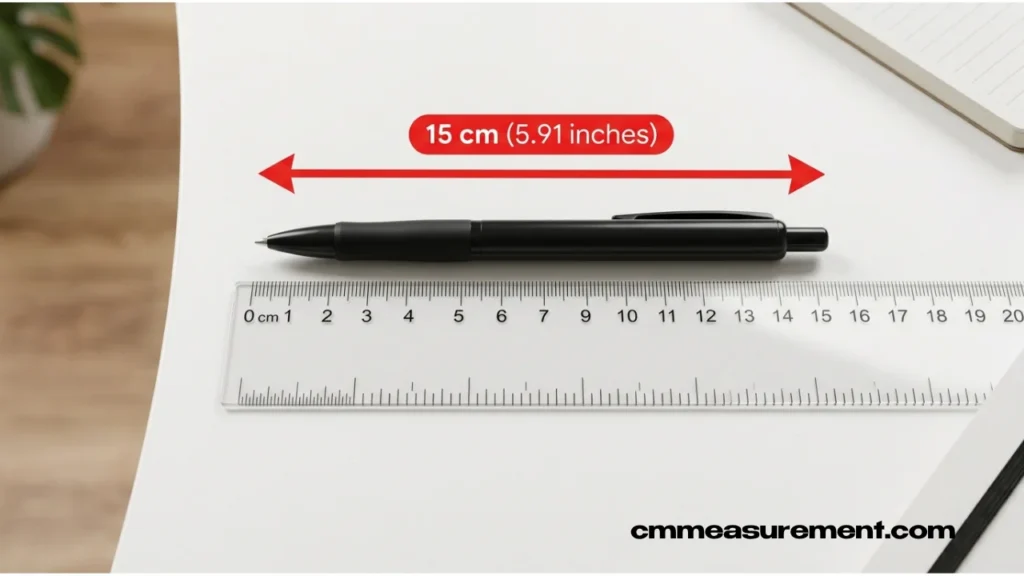
A ballpoint pen — The average pen runs close to 5.5 to 6 inches, putting it squarely in the same size range as 15 cm.
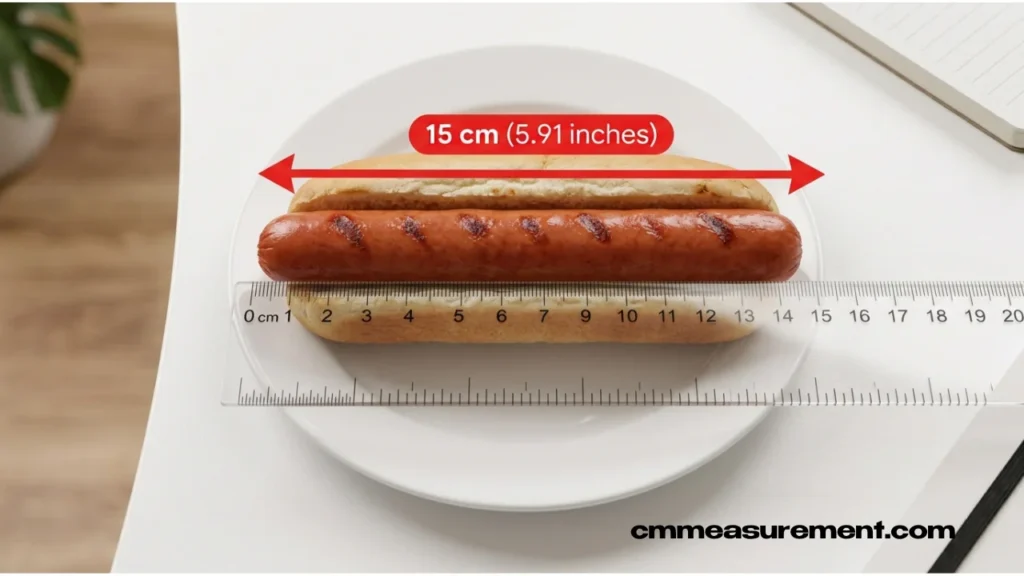
A hot dog — A standard hot dog, bun included, typically stretches around 6 inches, offering a quick, familiar visual.
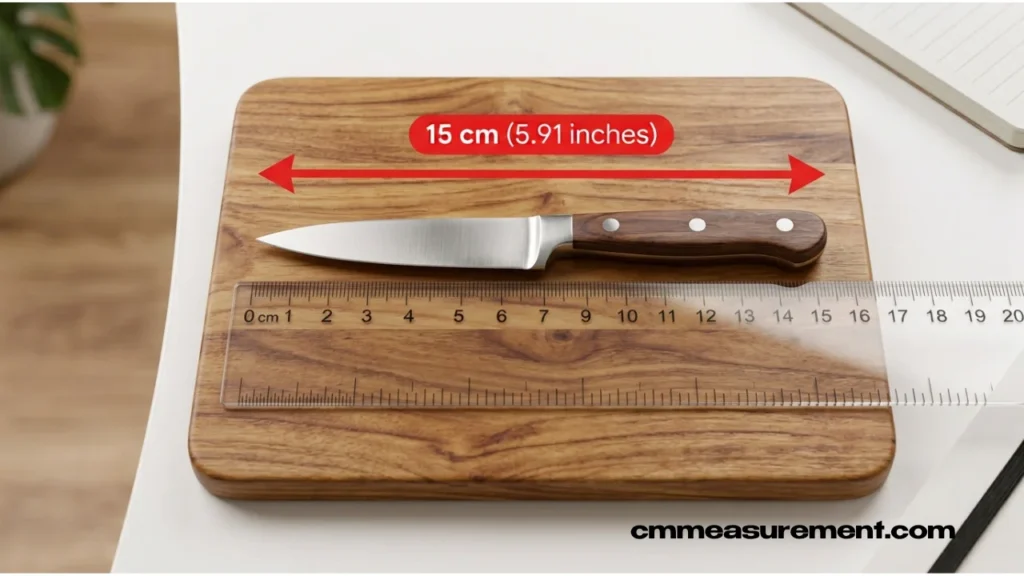
A small kitchen knife — Paring knives commonly have blades between 3 and 4 inches, but including the handle, the total length often nears 15 cm.
A DVD case’s width — The short side of a standard DVD case measures roughly 5.4 inches, close enough to give a solid mental picture of 15 cm.
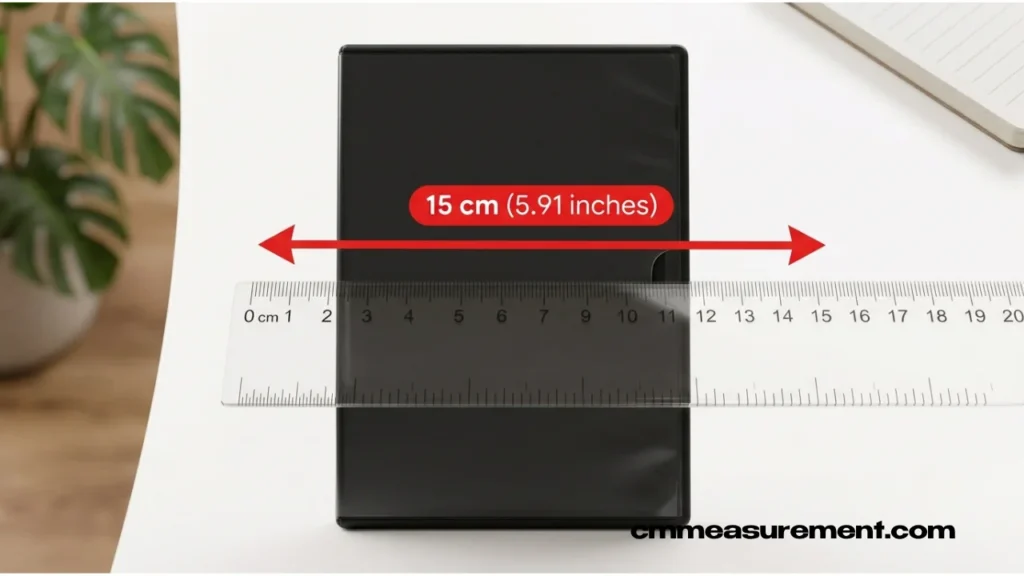
15 cm vs Nearby Measurements — Visual Comparison
Context matters as much as the raw number. Compared to 10 cm (about 3.94 inches, or roughly a credit card’s width), 15 cm is noticeably longer — about 50% more length.
Against 20 cm (7.87 inches, close to a standard smartphone plus a few inches), 15 cm falls short by roughly 2 inches.
A simple way to picture it: 15 cm is about the width of a standard sheet of paper (8.5 inches) minus two and a half inches — shorter than a full page width but longer than half of it. This kind of side-by-side framing helps the number feel tangible instead of abstract, especially for readers who think in inches, not centimeters, day to day.
FAQs
What does 15 cm look like?
Fifteen centimeters looks about as long as a standard smartphone or a dollar bill laid flat — roughly 5.9 inches, or just under six inches.
How long is 15 cm compared to an object?
It’s closest in size to a ballpoint pen, a paring knife with handle, or the width of a DVD case — all landing near the 5.9-inch mark.
What size is 15 cm in inches?
15 cm equals 5.91 inches (5.905515 inches precisely), using the standard conversion factor of 0.393701.
What items are 15 cm long? Common examples include smartphones, dollar bills, pens, hot dogs, small kitchen knives, and DVD cases — all measuring close to 5.9 inches.
What can I compare 15 cm to?
Compare it to a dollar bill (6.14 in), a smartphone (5.7–6.1 in), or roughly two-thirds the width of a standard 8.5-inch sheet of paper.
How long is 15 cm long?
15 cm measures 5.91 inches, or about 0.49 feet — just under half a foot in length.
Conclusion
Fifteen centimeters converts to 5.91 inches, or roughly 0.49 feet, using the fixed factor of 0.393701. Whether you’re comparing it to a smartphone, a dollar bill, or a kitchen knife, this measurement sits comfortably in the “just under six inches” range — an easy size to picture once you connect it to everyday objects.

Timmy Zeeshan is the founder and lead editor of CM Measurement, where he writes and maintains a growing library of unit conversion tools and practical measurement guides. With a background in engineering and a long-standing interest in everyday math problems, Timmy started CM Measurement after growing frustrated with cluttered, ad-heavy converter websites that made simple conversions harder than they needed to be.