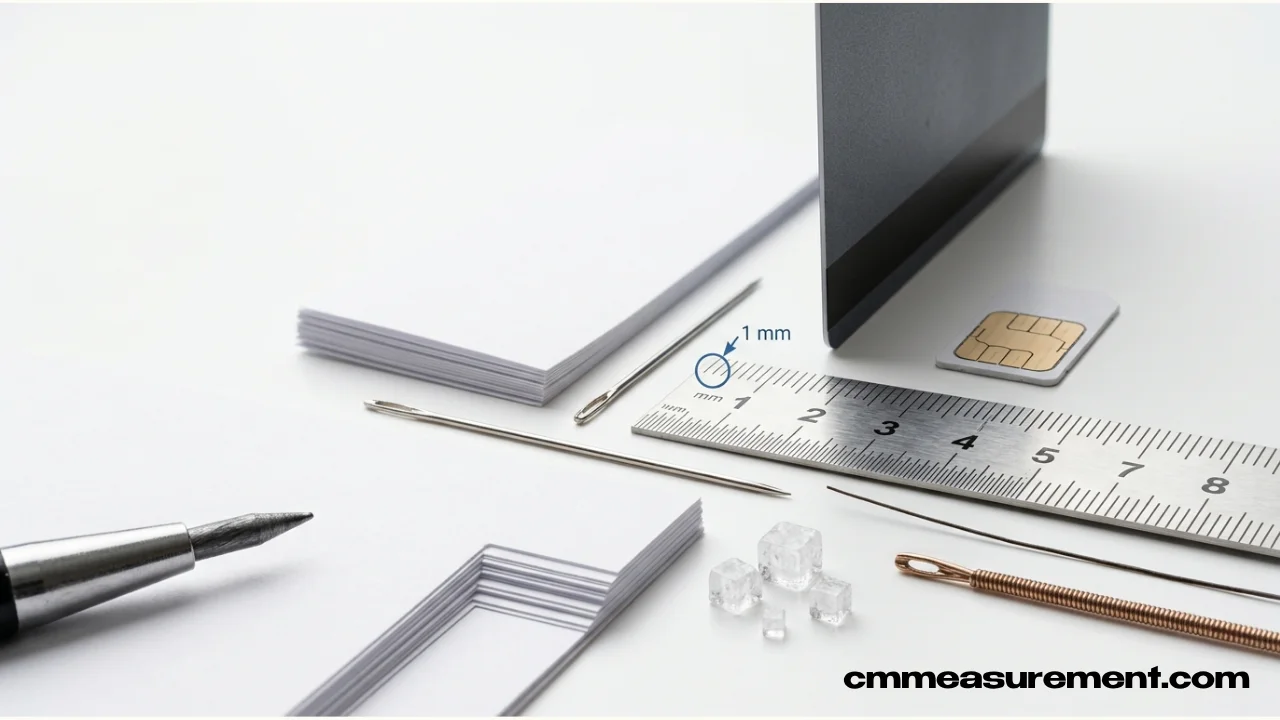
Trying to picture 1mm in your head? It’s harder than it sounds. A millimeter is one of the smallest units most people ever use, and without something physical to compare it to, the number just floats there, meaningless.
Here’s the quick answer: 1mm equals 0.0394 inches, or 0.1cm. That’s roughly as thick as a credit card. Below, you’ll find real objects, ruler tricks, and simple comparisons that make this tiny unit click instantly.
How Long Is 1mm in Inches and CM?
1 millimeter equals 0.03937 inches — most people round this to 0.04 inches. In centimeters, 1mm is exactly 0.1cm, since ten millimeters make up one full centimeter.
The conversion formula is simple: multiply millimeters by 0.03937 to get inches. So 1 x 0.03937 = 0.03937. This factor is set by the International Bureau of Weights and Measures (BIPM), the global authority that defines the metric system (BIPM SI Brochure).
Think of it this way: 1mm is roughly the thickness of a credit card, or about the width of a sharp pencil tip. It’s small enough that most rulers pack ten of them into every single centimeter mark. If you are interested to see cm into inches they must try this tool.
8 Real Life Things That Are 1mm Thick or Long
Numbers alone are forgettable. Objects stick. Here are 8 things you’ve likely handled today that measure close to 1 millimeter.
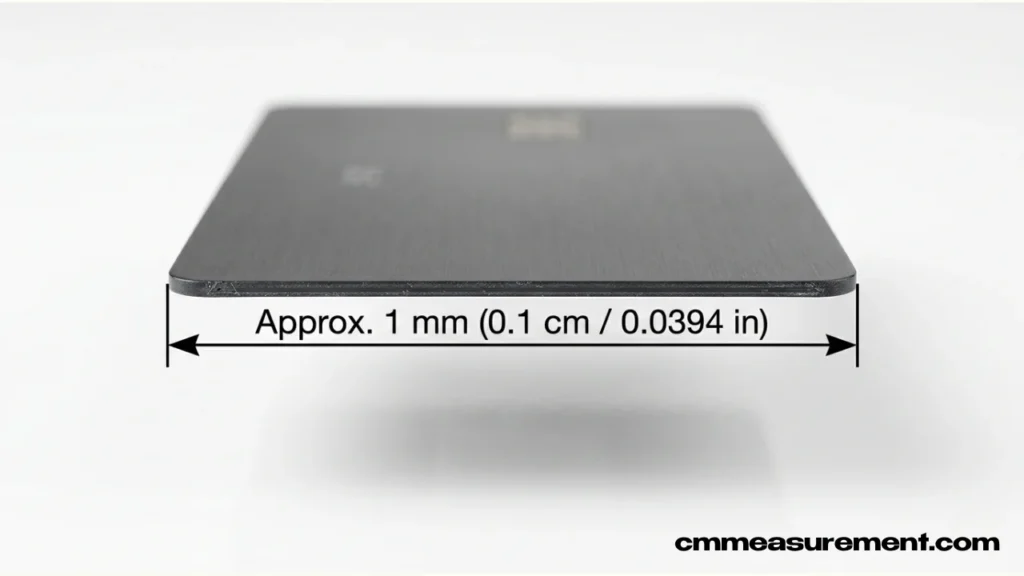
1. A credit card’s thickness Standard payment cards, following the ISO/IEC 7810 international standard, measure exactly 0.76mm thick — just under 1mm and a reliable everyday reference (ISO standard summary).
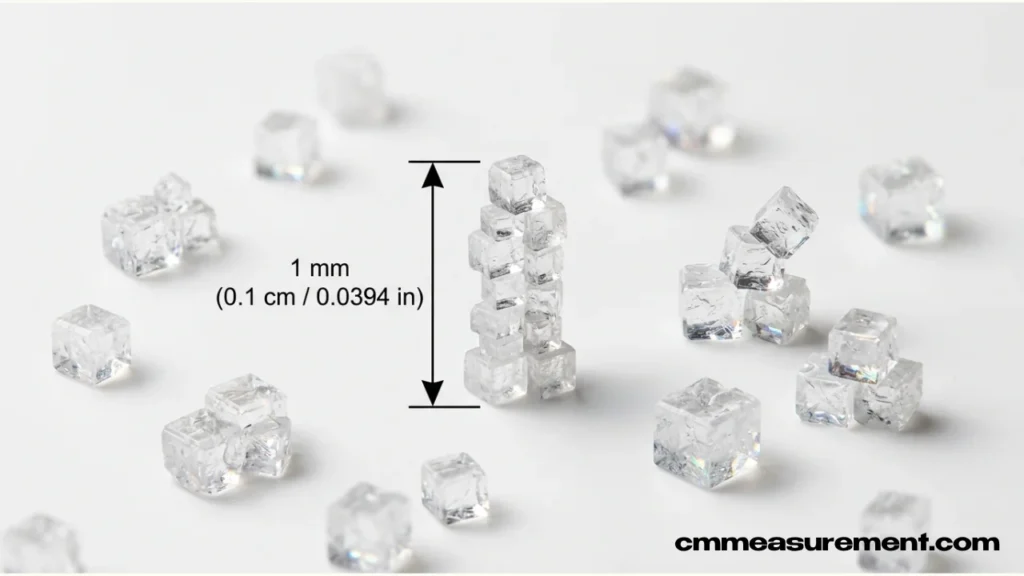
2. A grain of table salt A single grain of fine table salt typically measures between 0.3mm and 0.5mm. Stack two or three grains together and you’ll approach the 1mm mark.
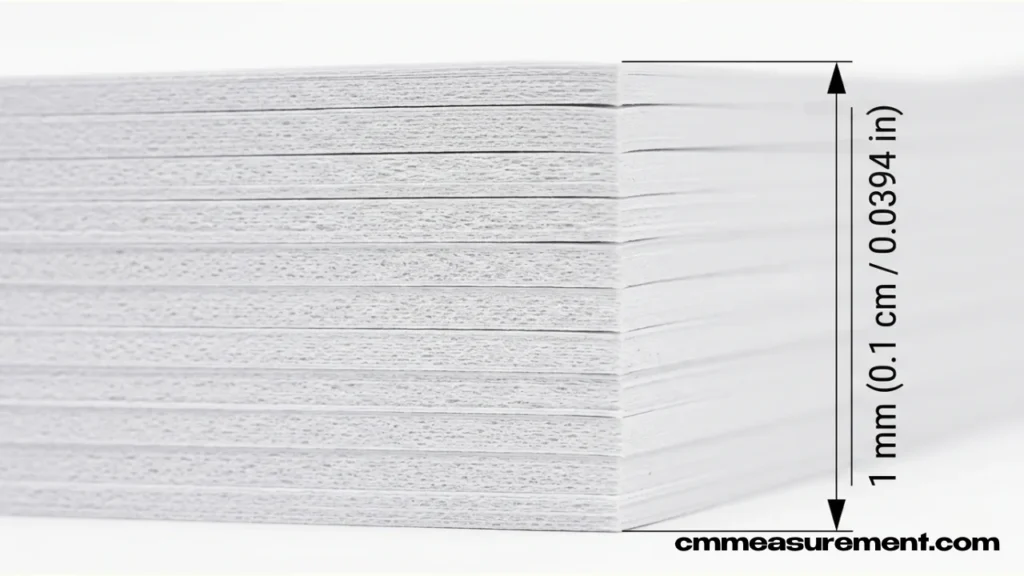
3. A sheet of standard printer paper Regular 20lb copy paper measures roughly 0.1mm thick. Stack ten sheets together, and you’ve built a stack exactly 1mm tall.
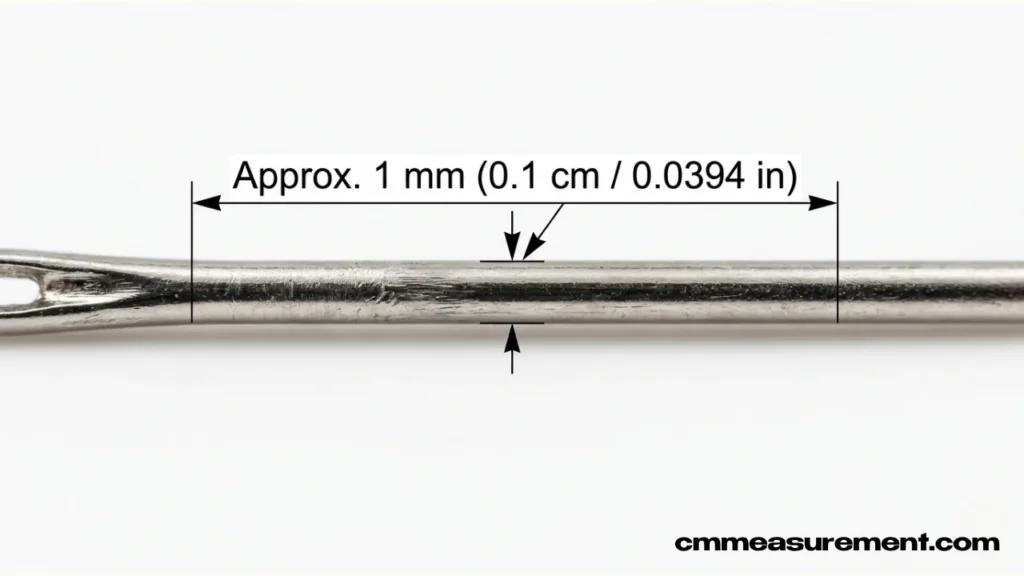
4. A sewing needle’s diameter Most household sewing needles measure between 0.6mm and 1mm across, depending on the needle size and intended fabric weight.
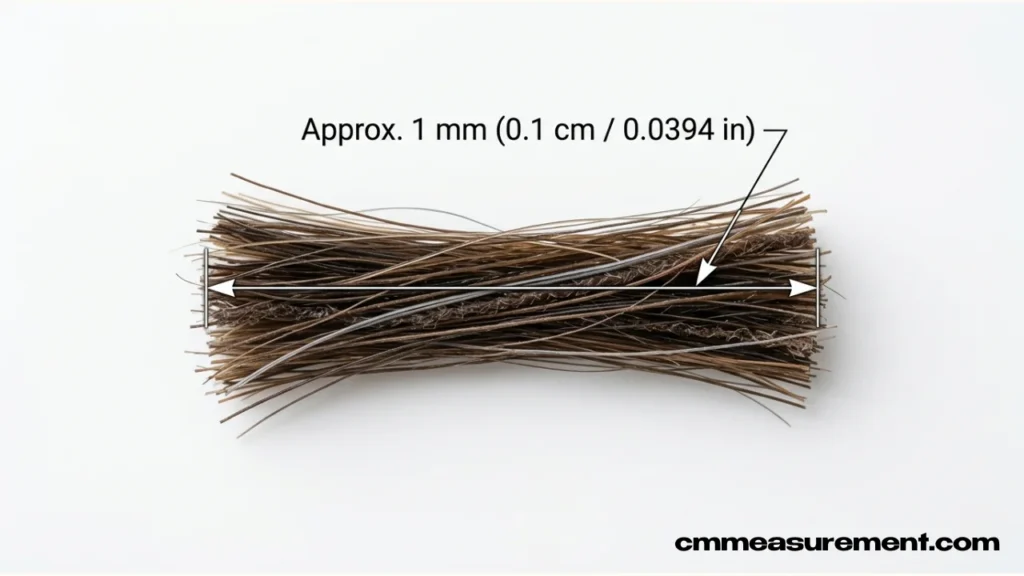
5. A strand of coarse human hair Human hair thickness varies widely, but coarse strands can measure up to 0.1mm to 0.18mm in diameter — meaning it takes roughly five to ten hairs bundled together to reach 1mm.
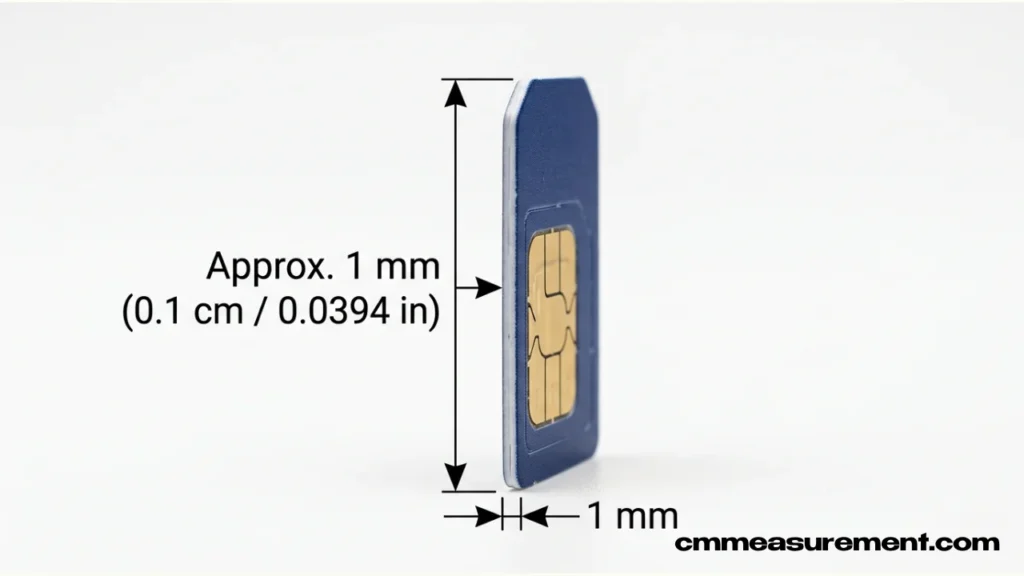
6. A SIM card’s thickness A standard SIM card measures about 0.76mm thick, nearly identical to a credit card, making it another pocket-sized reference point.
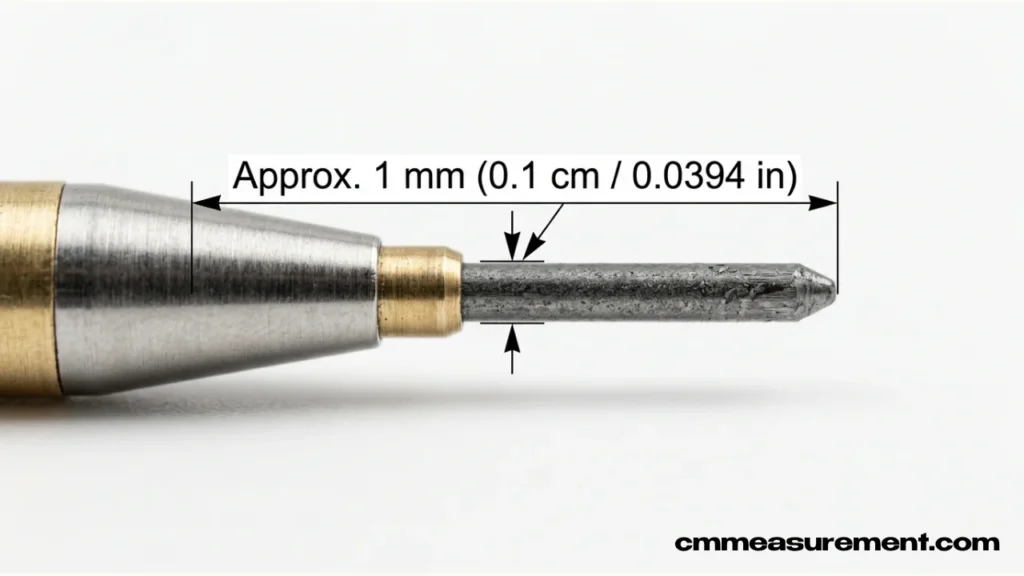
7. A mechanical pencil lead (1mm size) Mechanical pencils commonly come in 0.5mm, 0.7mm, and 1mm lead sizes. The 1mm variant is a direct, exact real-world match for this measurement.
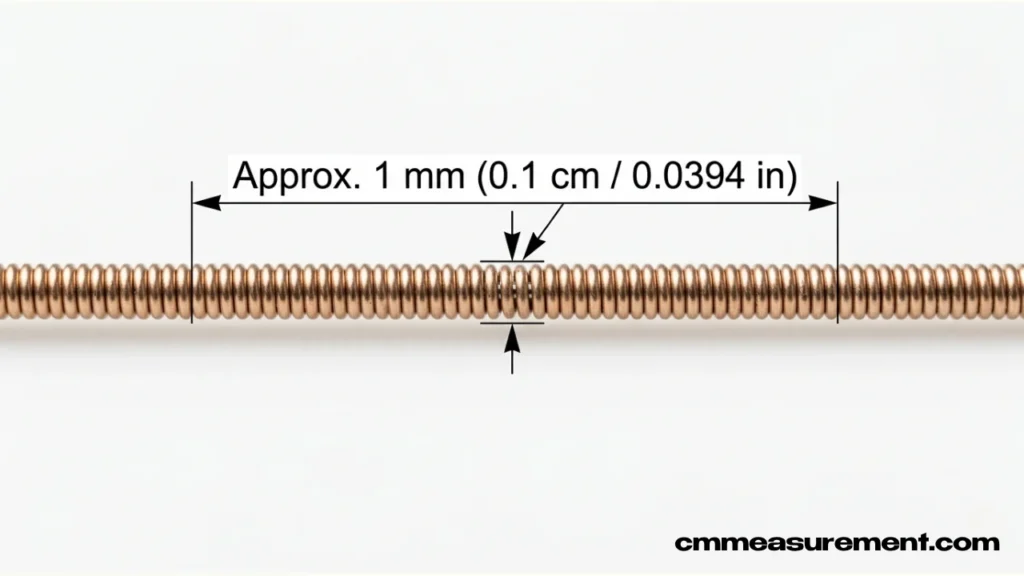
8. A guitar string’s diameter (light gauge) Light-gauge acoustic guitar strings, particularly the lower E string, often measure close to 1mm (roughly 0.052 inches) in diameter, according to standard string gauge charts used by manufacturers.
How to Read 1mm on a Ruler
Most people glance at a ruler and only notice the big, numbered centimeter lines. The small marks between them are where millimeters live, and learning to read them accurately is a genuinely useful skill.
Start by finding two centimeter lines. On a metric ruler, these are the longer, numbered marks. Between each pair, you’ll count exactly ten small unmarked lines — each one representing 1mm.
Count from the edge, not the number. Line up your object’s starting edge with the “0” mark, not the physical edge of the ruler itself, since rulers often have a small margin before the scale begins.
Use the tallest lines as checkpoints. Many rulers use a taller tick mark at the halfway point (5mm) between centimeter lines, making it faster to count without losing your place.
This small skill matters more than people expect — it’s the same logic used in sewing, engineering drawings, jewelry making, and even 3D printing calibration.
1mm Compared to Other Small Measurements
Seeing 1mm next to nearby measurements makes the scale click faster.
| Measurement | Inches | Everyday Object |
|---|---|---|
| 1mm | 0.039 in | Thickness of a credit card |
| 2mm | 0.079 in | Thickness of two stacked coins |
| 5mm | 0.197 in | Diameter of a pencil eraser |
| 1cm | 0.394 in | Width of a shirt button |
| 1 inch (25.4mm) | 1.00 in | Width of a standard matchbox |
One common mistake is confusing millimeters and centimeters when reading measurements quickly. Since 1cm equals 10mm, a decimal error here can throw off a measurement by a full order of magnitude — a mistake worth double-checking, especially in sewing, 3D printing, or precision crafts.
FAQs
What does 1 mm look like?
1mm looks like a tiny dash — about the thickness of a credit card or a single sheet of thick cardstock.
What is an example of something that is 1 mm?
A credit card’s thickness, a SIM card, or a 1mm mechanical pencil lead are all close, exact examples.
What object is 1 mm in size?
A sewing needle’s diameter or a stack of ten sheets of printer paper both land right around 1mm.
How big is 1 mm in length?
1mm equals 0.0394 inches, or 0.1cm — one-tenth the length of a centimeter.
How big is 1 mm visually?
Visually, 1mm is barely larger than a pinpoint — smaller than the width of most fingernail edges, but still visible without magnification.
What is the size of 1 mm?
1mm is 0.0394 inches, or roughly the thickness of a standard credit card.
Conclusion
1 mm equals 0.0394 inches, or 0.1cm — about the thickness of a credit card sitting in your wallet right now. Instead of trying to memorize the number, anchor it to that card, or to the small unmarked lines between the centimeter marks on any ruler.
Once you can count mm lines on a ruler without hesitating, this tiny unit stops feeling abstract. It becomes something you can spot, measure, and trust — in sewing, DIY projects, or anywhere precision counts.

Timmy Zeeshan is the founder and lead editor of CM Measurement, where he writes and maintains a growing library of unit conversion tools and practical measurement guides. With a background in engineering and a long-standing interest in everyday math problems, Timmy started CM Measurement after growing frustrated with cluttered, ad-heavy converter websites that made simple conversions harder than they needed to be.