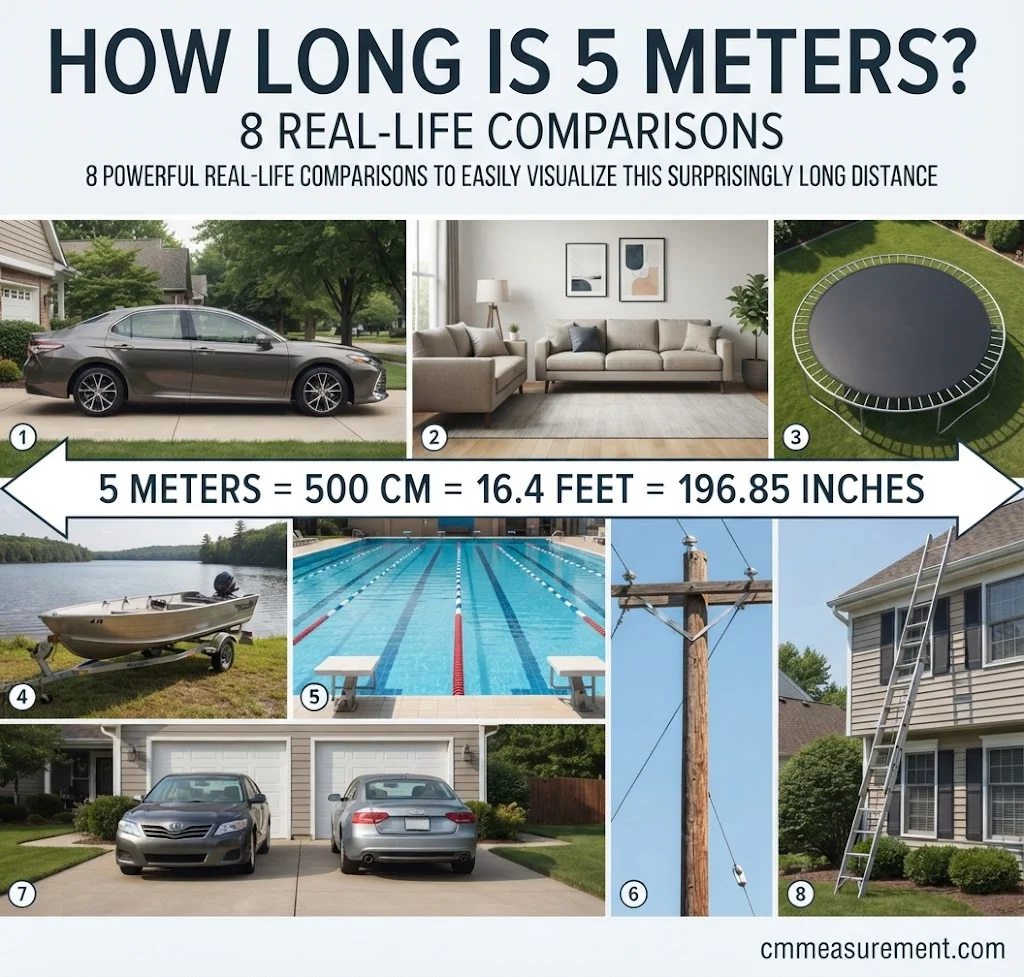
Five meters catches people off guard. It’s longer than a parked sedan and wide enough to swallow most bedroom walls.
This guide gives you the exact conversion, a room-scale gut check, and eight real comparisons that make how long 5 meters actually is click instantly.
Table of Contents
What Size Is 5 Meters in Feet?
Let’s start with the number itself. Five meters equals 16.4 feet, or more precisely, 16 feet and 4.8 inches.
That figure comes from a fixed constant confirmed by the National Institute of Standards and Technology (NIST): one meter equals 3.280839895 feet. Multiply that by 5, and you get 16.404199475 feet.
Rounding down to “16 feet” is common, but it skips nearly half a foot. That gap matters if you’re measuring a bedroom wall, a fence line, or a driveway where every inch counts.
Here’s the quick breakdown:
| 5 Meters Equals |
|---|
| 16.4 feet |
| 16 feet, 4.8 inches |
| 196.85 inches |
| 5.47 yards |
| 500 centimeters |
How Long Is 5 Meters in a Room?
How long is 5m in a room? In a typical US home, this is whole-room territory, not single-wall territory.
Picture a small-to-medium bedroom. Many US bedrooms measure somewhere between 10 and 14 feet on a side, so 16.4 feet stretches noticeably beyond a standard wall — closer to the length of a combined living-dining space or a one-car garage floor.
This scale matters for practical reasons. If you’re laying out furniture, sizing an area rug, or planning where a sectional sofa will fit, knowing that 5 meters equals roughly 16 feet keeps your measuring tape honest before the moving truck arrives.
Compare that to a hallway or a walk-in closet, both usually under 6 feet wide, and the difference becomes obvious. Five meters isn’t a corridor measurement. It’s a full-room one.
8 Powerful Real-Life Comparisons for 5 Meters
How long is 5 meters in real life? These eight comparisons turn an abstract number into something you can actually picture.
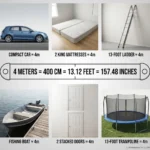
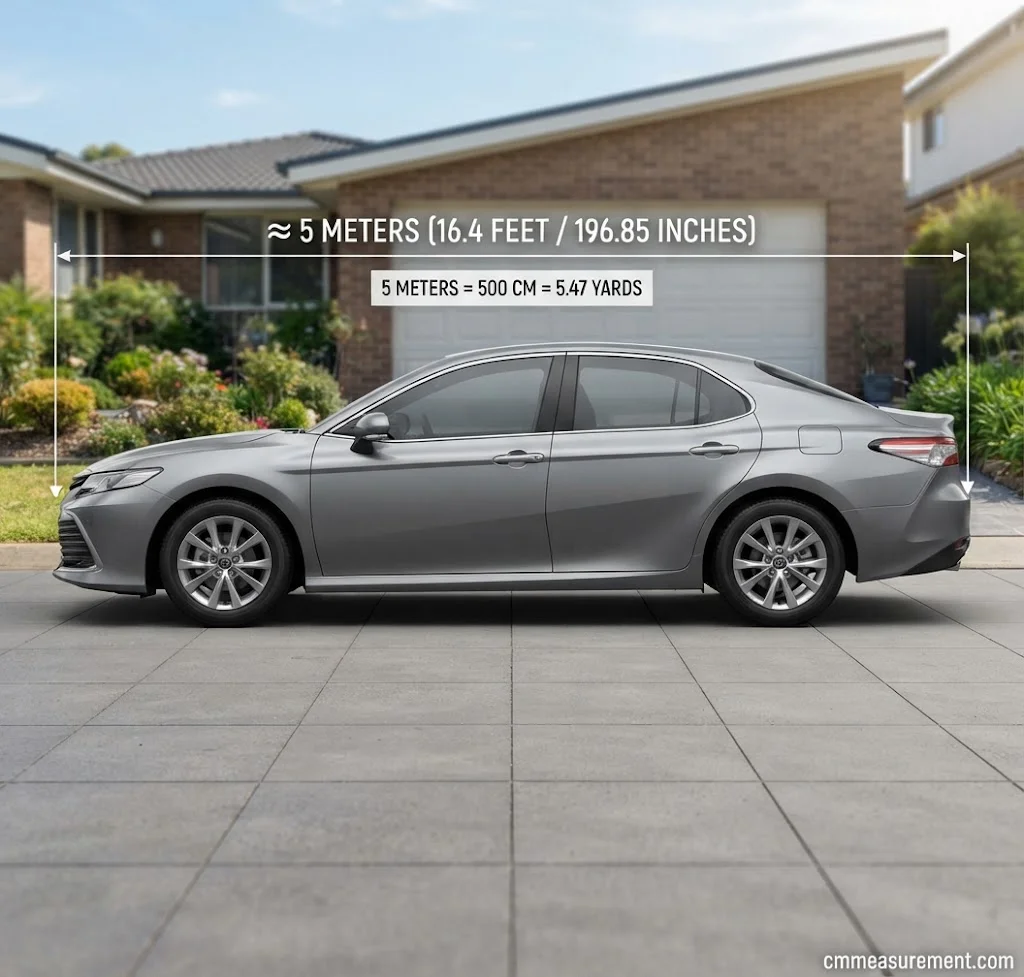
A mid-size sedan. Popular family sedans measure close to 16 feet bumper to bumper. If you’ve ever backed one into a driveway, you’ve physically occupied almost this exact length.
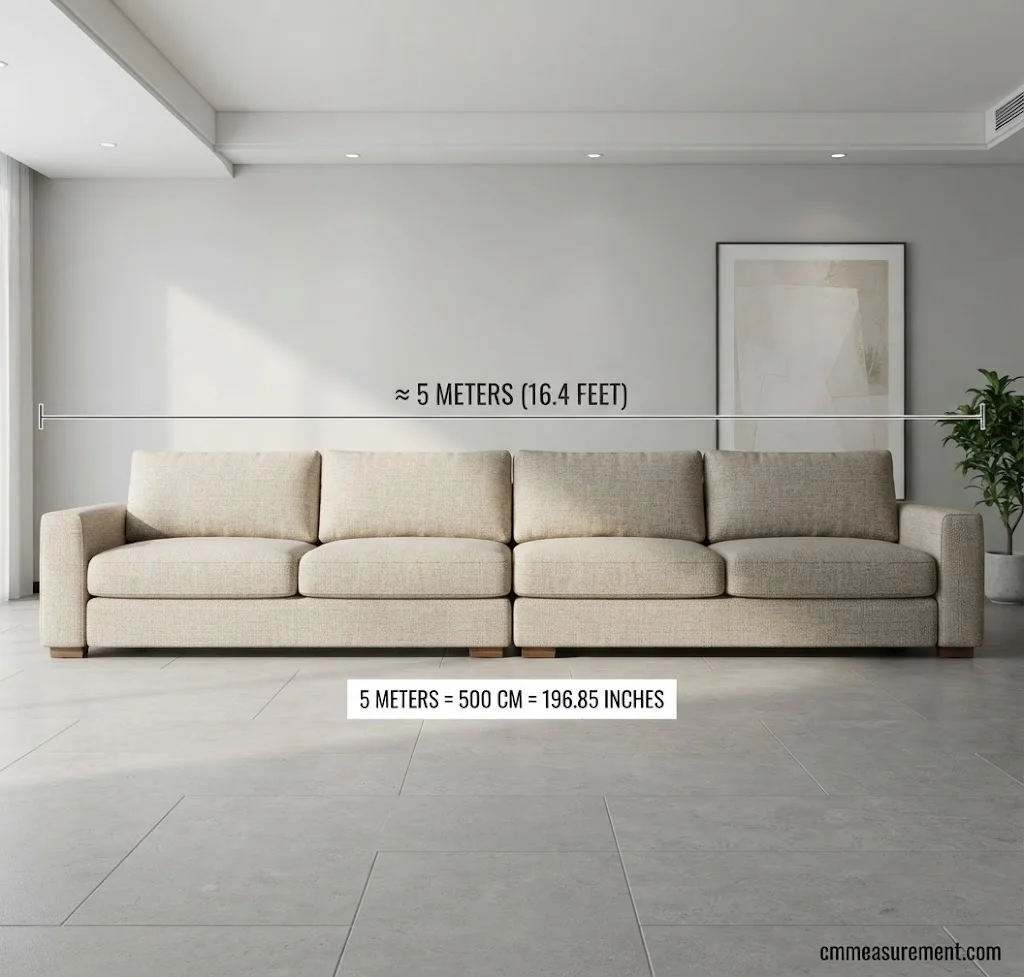
Two full-size sofas placed end to end. A typical sofa runs about 7 feet long, so lining up two gets you remarkably close to the 5-meter mark. Anyone who’s rearranged a living room has likely eyeballed this exact comparison without realizing it.
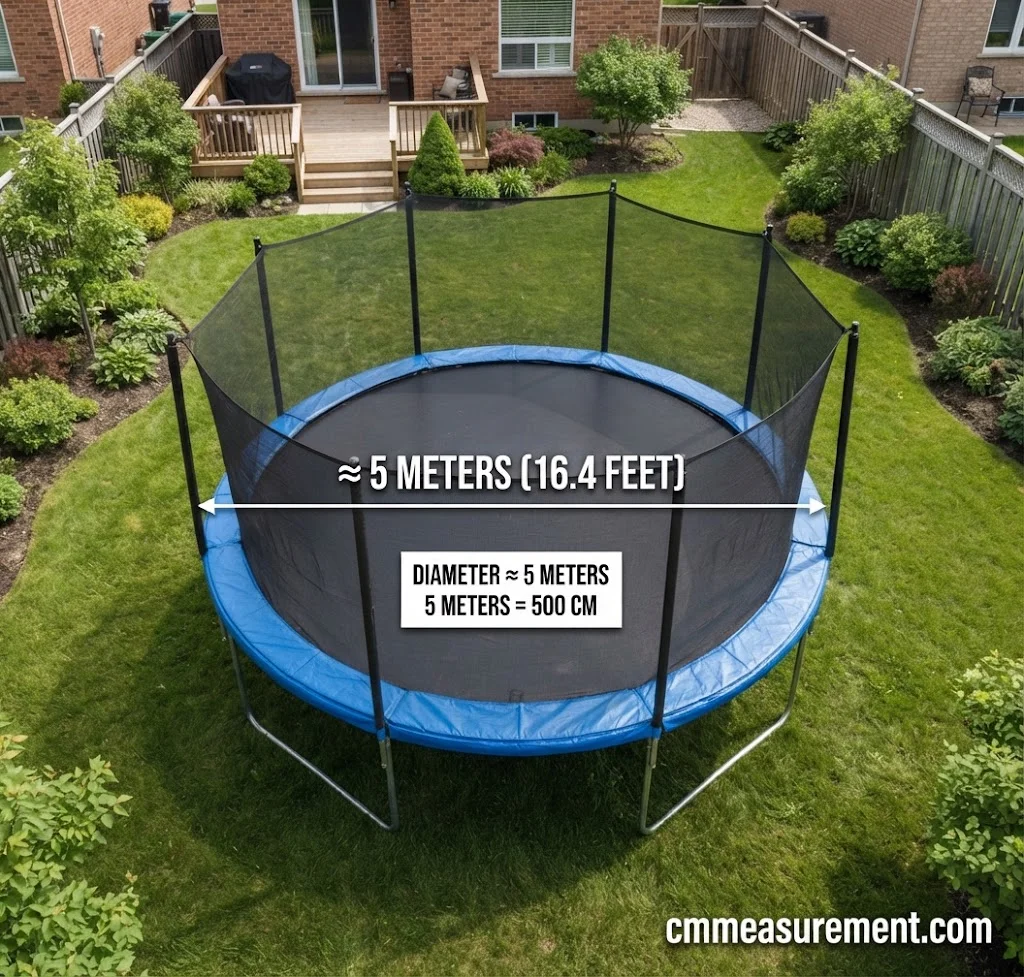
A 16-foot backyard trampoline. These larger round trampolines measure close to 5 meters across. Families with one in the yard already have a daily, walk-past reference for this length.
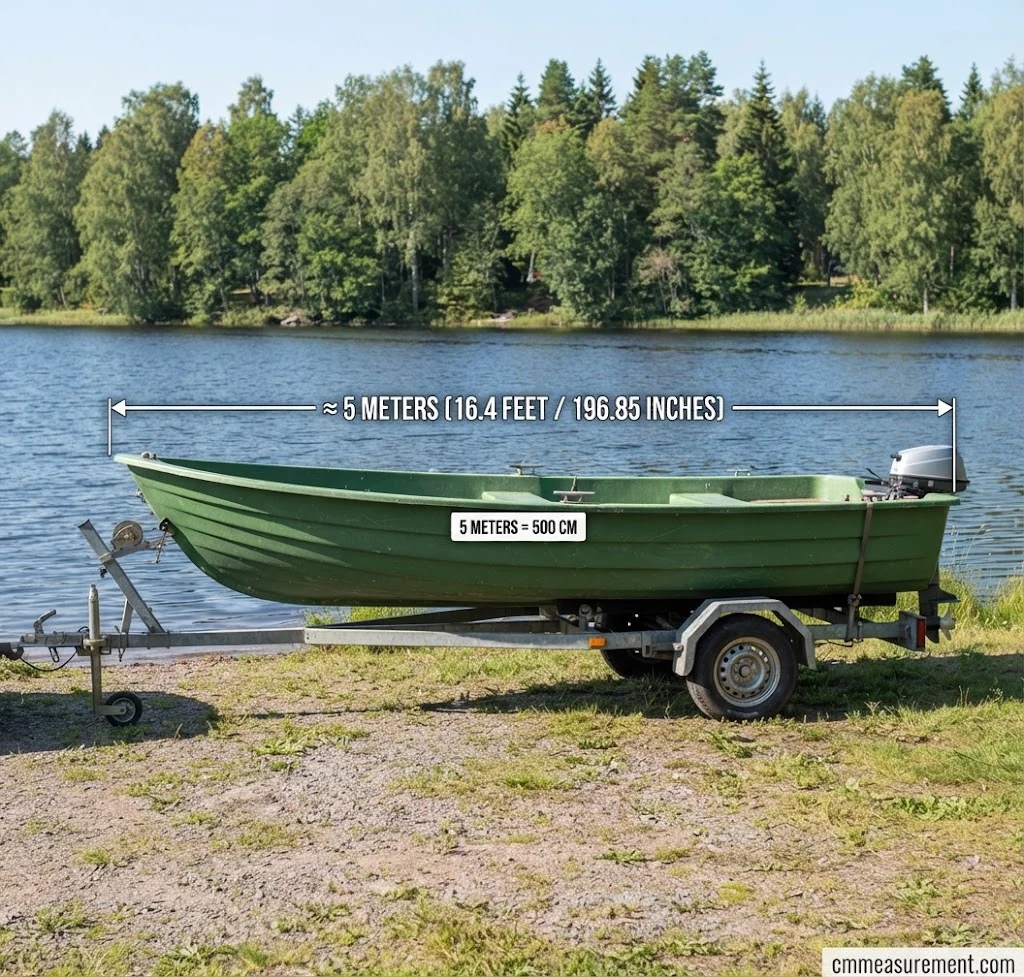
A small fishing boat or canoe. Recreational canoes commonly run between 15 and 17 feet long. Paddling one across a lake means you’re moving a vessel almost exactly this size through the water.
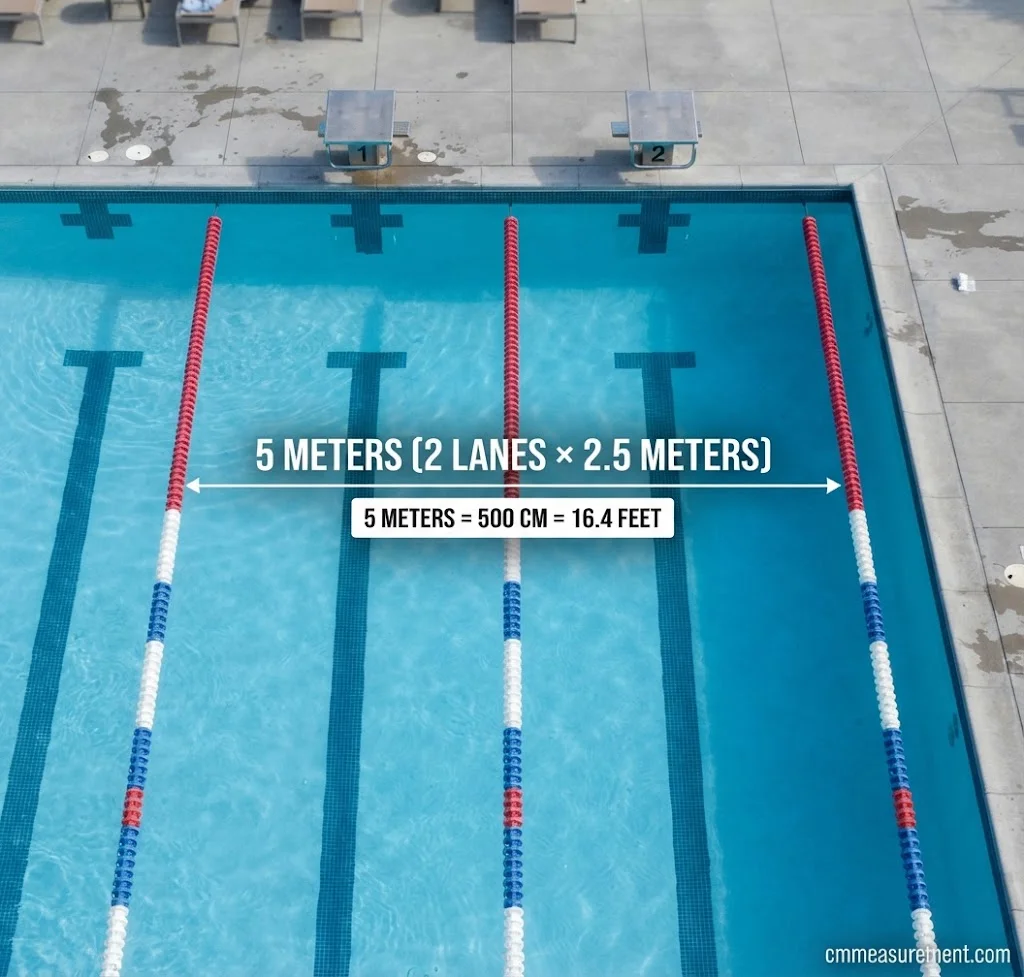
Two swimming pool lanes, side by side. Competition pool lanes are standardized at 2.5 meters wide, according to World Aquatics, the sport’s governing body. Two lanes together land precisely at 5 meters — a rare case where the comparison is exact, not approximate.
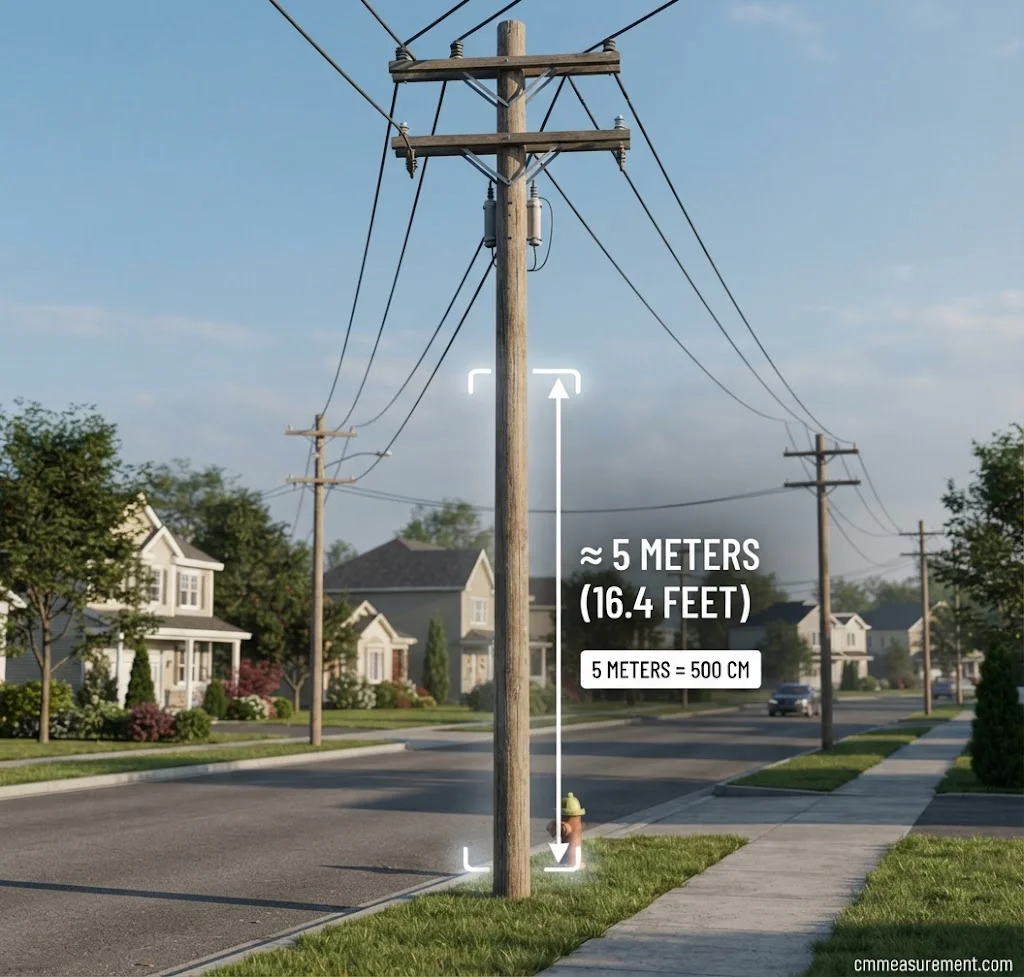
Half of a standard utility pole. Wooden utility poles commonly stand around 10 to 11 meters tall above ground. Slice one in half, mentally, and you land right at this measurement — a handy vertical reference for a horizontal number.
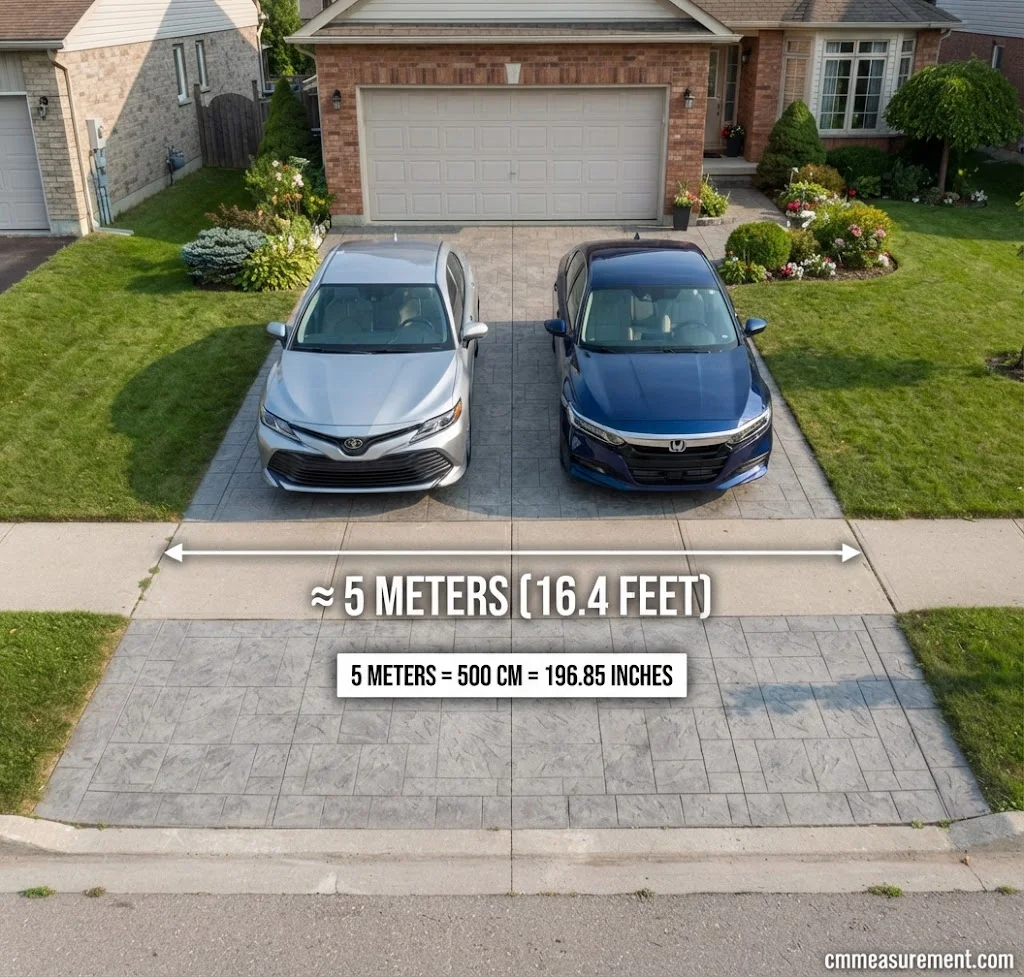
A two-car residential driveway’s width. Many US driveways built for two vehicles side by side measure close to 16 feet across. If you’ve ever parked two cars next to each other at home, you’ve used almost this exact width.
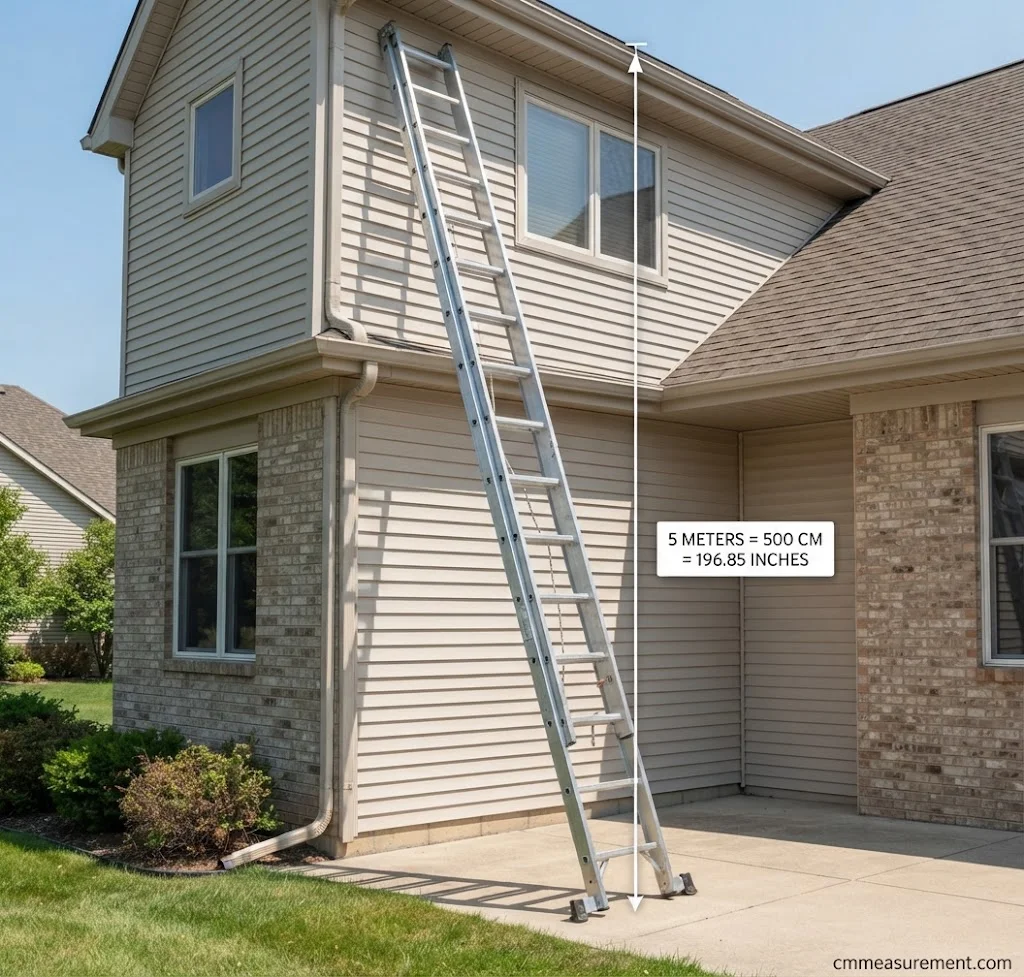
A 16-foot extension ladder, fully extended. Consumer extension ladders commonly reach this length when fully open. Anyone who’s cleaned a second-story gutter has leaned this precise measurement against their house.
How Long Is a Meter Visually? (The Building Block)
Before stretching to 5 meters, it helps to anchor the smaller unit first. How long is a meter visually? One meter equals about 3.28 feet, roughly the length of a baseball bat.
What object is equivalent to a meter? A full-size acoustic guitar works well too, measuring close to this exact length from headstock to base. So does a yardstick with a few extra inches tacked on.
Five meters isn’t some unfamiliar new quantity. It’s simply that same guitar-length reference, repeated five times over. Line up five baseball bats end to end, and you’ve rebuilt the entire distance from something you already know.
How to Estimate 5 Meters Without a Tool
No tape measure on hand? These two methods get remarkably close.
The stride-count method. One long, deliberate adult stride covers close to a meter. Count out five or six confident steps in a row, and you’ll land right around 5 meters — a technique surveyors relied on long before laser measuring tools existed.
The object-reference method. Use the sedan or driveway width from the comparison list above as your mental anchor. Once one of those lengths is locked into memory, you can size up other distances against it with solid accuracy.
Neither method replaces a real measuring tape for precision work, but both work well for fast, everyday estimates.
FAQs
How long is 5m in a room?
It’s whole-room scale — close to 16.4 feet, which stretches beyond most standard bedroom walls and into the size of a combined living space or a one-car garage floor.
What size is 5 meters in feet?
Five meters equals 16.4 feet, or 16 feet and 4.8 inches. The exact conversion factor is 1 meter = 3.280839895 feet.
How long is 5 meters in real life?
It shows up as a mid-size sedan’s length, two pool lanes side by side, or a fully extended 16-foot ladder.
How long is 5m visually?
Picture two full-size sofas placed end to end, or a small canoe resting on a dock. Both examples sit right around 5 meters.
How long is a meter visually?
One meter looks like a baseball bat or a full-size guitar, measuring about 3.28 feet. Five meters is simply that length repeated five times.
What object is equivalent to a meter?
A full-size acoustic guitar or a yardstick with a few extra inches both measure close to one meter, making either a solid visual reference.
Conclusion
Five meters stops feeling like an abstract number once you tie it to a sedan, two pool lanes, or a ladder against your house. Keep these eight comparisons in your back pocket, and this measurement will make sense the moment it comes up again.

Timmy Zeeshan is the founder and lead editor of CM Measurement, where he writes and maintains a growing library of unit conversion tools and practical measurement guides. With a background in engineering and a long-standing interest in everyday math problems, Timmy started CM Measurement after growing frustrated with cluttered, ad-heavy converter websites that made simple conversions harder than they needed to be.